All courses / Landscape
About the course
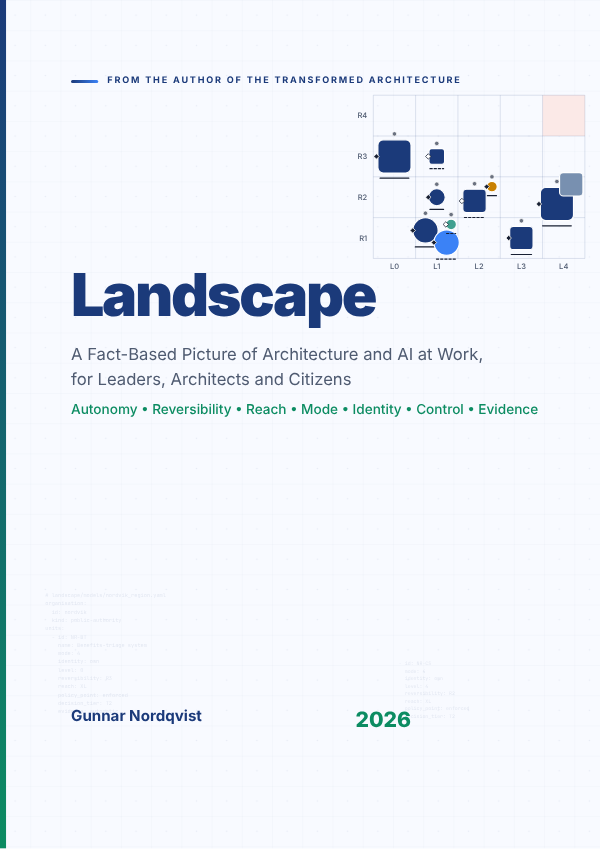
The course follows the book Landscape, a companion to the series The Transformed Architecture, in its four parts. It opens with a test of fourteen fact questions answered from public datasets and teaches Contour, a notation that draws every AI use as one mark with seven dimensions. It then takes nine instincts that make leaders, architects and citizens misread this landscape, each with its evidence and one rule of thumb. The third part is practical: participants draw their own organisation's landscape from records it already keeps and read it over time, by supplier and jurisdiction, and by who decides and how anyone knows. The last part applies the rules to real documents and looks ahead, with every statement about the future labelled observable, expected or speculation.
After the course the participant can
- State the measured answers to the book's test questions with their year, source and denominator.
- Read a one-page landscape in Contour in a fixed order, starting with the empty corner and ending with the names.
- Identify the nine instincts in a document or a discussion and apply the rule of thumb that answers each.
- Draw the one-page landscape of an organisation from records it already keeps, and list the gaps as findings.
- Read change over a year, supply and jurisdiction, decision rights and evidence in the views V2 to V5.
- Compare two landscapes at identical scales without ranking them.
- Grade a source and restate a lone number with its denominator, comparison and definition.
- Label statements about the future as observable, expected or speculation, and write a projection that can be shown wrong.
Three ways to run it
The same material in three lengths. Each row of an agenda names the lessons it draws on.
Executive briefing90 minutes
For executive teams, boards, elected committees and their advisers
A short test, one picture and a handful of questions. Participants answer five of the book's questions before seeing the measured answers, learn to read a one-page landscape in thirty seconds on the two fictional organisations, and leave with the nine rules of thumb and the questions to ask of any AI proposal: at which level, how reversible, who holds the seat, and whether the evidence is automatic or a promise.
| 0:00 | Five questions from the test, answered in writing before the measured answers are shown Ch. 1 |
| 0:15 | The measured answers, and why wrong answers have a direction Ch. 1, Ch. 2 |
| 0:30 | One mark read aloud, and a one-page landscape read in six steps Ch. 3, Ch. 4 |
| 0:50 | Three instincts a board meets most: the box, the fear and the blame instinct, each with its rule of thumb Ch. 5, Ch. 9, Ch. 13 |
| 1:10 | Who decides and how we know: seats, stop drills and evidence against attestation Ch. 17 |
| 1:20 | The nine rules on one page and what to ask on Monday Ch. 19, Ch. 20 |
One-day seminar1 day
For architects, risk and compliance staff, public officials and managers who will draw or commission a landscape
A working day that moves from the test to a first hand-drawn landscape. The morning covers the notation and the nine instincts with their evidence. The afternoon is practical: participants draw a one-page landscape for their own organisation or for Nordvik Region, read it for decision rights and evidence, and apply the nine rules of thumb to a document they brought.
| 09:00 | The test, the measured answers and the five grades of source Ch. 1 |
| 09:45 | The old pictures and the vocabulary of the new landscape Ch. 2, Ch. 3 |
| 10:30 | Contour: seven dimensions, three frames, six views, and pen and paper Ch. 4 |
| 11:15 | Instincts about what a unit is: box, binary and model Ch. 5, Ch. 6, Ch. 7 |
| 12:00 | Instincts about numbers and stories: straight line, fear and size Ch. 8, Ch. 9, Ch. 10 |
| 13:30 | Instincts about decisions: destiny, single perspective and blame Ch. 11, Ch. 12, Ch. 13 |
| 14:15 | Workshop: a first one-page landscape from the records you have, with its list of gaps Ch. 14 |
| 15:15 | Reading the landscape over a year, by supplier and jurisdiction, and by decision rights and evidence Ch. 15, Ch. 16, Ch. 17 |
| 16:00 | Two landscapes compared, and the nine rules applied to a document each participant brought Ch. 18, Ch. 19 |
| 16:40 | The next years under three labels, and each participant's Monday list Ch. 20 |
Full course8 weeks, two to three lessons a week
For teams and individuals who will keep a landscape of their organisation and use it in decisions, reviews and reporting
All twenty lessons in the order of the book, with a lecture for each part. Participants take the test in the first week and again in the last, build a landscape of their own organisation step by step through the views V1 to V6, apply each rule of thumb to material from their own work, and finish with a capstone: a landscape pack with a labelled outlook, presented to a mixed audience.
| Week 1 | Part I: the test, the old pictures, the new landscape and the notation Ch. 1, Ch. 2, Ch. 3, Ch. 4 |
| Week 2 | Part II: the box, binary and model instincts Ch. 5, Ch. 6, Ch. 7 |
| Week 3 | Part II: the straight-line, fear and size instincts Ch. 8, Ch. 9, Ch. 10 |
| Week 4 | Part II: the destiny, single-perspective and blame instincts Ch. 11, Ch. 12, Ch. 13 |
| Week 5 | Part III: the one-page landscape and the landscape over a year Ch. 14, Ch. 15 |
| Week 6 | Part III: supply, sovereignty and jurisdiction; decision rights and evidence Ch. 16, Ch. 17 |
| Week 7 | Part III and Part IV: two landscapes compared, and the rules of thumb in practice Ch. 18, Ch. 19 |
| Week 8 | Part IV: the next years and a conclusion; the test retaken; capstone presentations Ch. 20 |
Modules and lessons
One module for each part of the book and one lesson for each chapter. A lesson has learning objectives, key concepts, a teaching plan, discussion questions, an exercise and a self-test.
Module 1 · Part I · The Test and the Picture
Part I gives the participant the test, the picture and the vocabulary. It opens with fourteen fact questions answered from public datasets, shows why the four familiar pictures of technology at work hide what the data show, defines the landscape of who acts, with whose identity and under whose decision, and teaches Contour, the notation that draws every AI use as one mark with seven dimensions. The participant leaves able to read a one-page landscape in a fixed order and to sketch one by hand. Lecture: A test, four old pictures and one new one
Module 2 · Part II · The Instincts
Part II takes the nine instincts one at a time: box, binary, model, straight-line, fear, size, destiny, single-perspective and blame. Each lesson follows the chapter's form: the test questions the instinct explains, a fair hearing for the instinct, the evidence with its limits, the picture corrected with a view in Contour, and one rule of thumb with the place where it stops applying. The participant leaves with nine rules and has applied each to a landscape or a document of their own. Lecture: Nine instincts, nine rules of thumb
- Chapter 5The Box Instinct: AI Is Not One Thing75 min
- Chapter 6The Binary Instinct: Neither Automated Nor Manual90 min
- Chapter 7The Model Instinct: The Use Sets the Risk and the Value90 min
- Chapter 8The Straight-Line Instinct: Curves That Bend75 min
- Chapter 9The Fear Instinct: The Loud Harms and the Quiet Ones90 min
- Chapter 10The Size Instinct: Numbers Without Denominators75 min
- Chapter 11The Destiny Instinct: Nothing Here Is Fixed, and Nothing Is Inevitable90 min
- Chapter 12The Single-Perspective Instinct: Security, Compliance and Productivity Share One Landscape90 min
- Chapter 13The Blame Instinct: When Nobody Designed Who Decides90 min
Module 3 · Part III · Drawing Your Landscape
Part III is practical. The participant draws a one-page landscape from the records the organisation already keeps, reads a year of change in the time view, places the same marks by supplier role and jurisdiction, reads who decides and where the proof comes from, and compares two landscapes at the end of a modelled year. Each lesson produces an artefact of the kind the chapter describes: a V1 with its list of gaps, a V2 with timeline notes, a V3, a decision record with V4 and V5 rows, and a V6 with a review plan. Lecture: Drawing your landscape: from records to six views
- Chapter 14The One-Page Landscape: Drawing It From What You Already Have120 min
- Chapter 15The Landscape Over a Year: Reading Change90 min
- Chapter 16Supply, Sovereignty and Jurisdiction: Where the Landscape Runs90 min
- Chapter 17Decision Rights and Evidence: Who Decides, and How We Know105 min
- Chapter 18A Year at Nordvik Region and Hansa Mutual: Two Landscapes Compared105 min
Module 4 · Part IV · Seeing Clearly
Part IV turns the book into practice and looks ahead. The participant applies the nine rules of thumb to five kinds of document, as an executive, an architect, a public official, a journalist and a citizen would, and then sorts the next years under the labels observable, expected and speculation. The module ends with a projection written so that it can be shown wrong, the test retaken with reasons, and a dated list of what to do on Monday. Lecture: Seeing clearly: nine questions, three labels and Monday
Final assignment
Capstone
A landscape pack for one organisation, with a labelled outlook
Produce a landscape pack for your own organisation, or, if you cannot use real material, for Nordvik Region or Hansa Mutual extended with a scenario of your own. The pack draws every AI use as one mark in Contour, from the records the organisation already keeps, and reads it in the standard views: the one-page landscape, change between two dates, supply and jurisdiction, decision rights and evidence. It lists the gaps as findings with an owner and a date, applies the nine rules of thumb to one real document about AI in the organisation, and ends with an outlook in which every statement about the future carries one of the three labels. Present it in fifteen minutes to a mixed audience that reads it from the productivity, security and compliance chairs.
Steps
- Count the units from the inventory, mandates, delegation records, contracts and proxy logs, naming uses and not products, and include the Mode 0 uses nobody chose.
- Record the seven dimensions for each unit, assessing reversibility and reach, finding the seat, and using the unknown value or the worst defensible case with a note where a field cannot be filled.
- Draw V1 and, by hand or from a model, V2 between two dates, V3 with suppliers by role and jurisdiction, and the V4 and V5 rows for the units at Level 3 and above or at R3 and above.
- Write the list of gaps and, for the mark that worries you most, a one-page review ending in a decision record with holder, tier, ceiling per action class, policy point and stop path.
- Apply the nine rules of thumb to one real document about AI in the organisation and rewrite its opening paragraph.
- Write an outlook of labelled statements, with one projection that says what would show it wrong and when it will be reviewed.
Deliverables
- A landscape pack: V1 with legend, V2, V3, and V4 and V5 rows for the selected units, each captioned illustrative where it is not rendered from real records
- A table of units with their seven dimensions and the source record of each field, and the list of gaps with an owner and a date
- One decision record with a stop path and budget for the selected unit
- One real document annotated with the nine rules and its rewritten opening paragraph
- A one-page outlook with every statement labelled observable, expected or speculation
Assessment criteria
- Every unit is a use and not a product, the Mode 0 units are included, and no unit is left out because a field is unknown.
- The notation is used exactly: levels, tiers, reach classes, modes, shapes, diamond, seat and baseline mean what the book defines, and suppliers are labelled by role and never by brand.
- Every number carries its source, period and denominator, estimates are called estimates, and nothing is extended past its last point.
- The findings name absences as findings, each with a holder and a date, and the pack does not rank the organisation against another.
- Statements about the future are labelled, and the projection states what would show it wrong.