All courses / AI Leader
About the course
The course follows AI Leader, Book 11 of The Transformed Architecture, through its seven parts. It starts with the leadership role in question and the frame of the book: five leadership functions, a delegation ladder with a ceiling and the answerability principle. It then works through the craft of each function, the leadership positions from the board to the first line, the leading of adoption, trust, co-determination and crises, the constraints of regulation, ethics and dependency, the leader as a person, and a year in two organisations with a verdict on the thesis. It matters because European law assigns duties to named people and bodies, and because claims about AI adoption, productivity and competence need evidence that has a date.
After the course the participant can
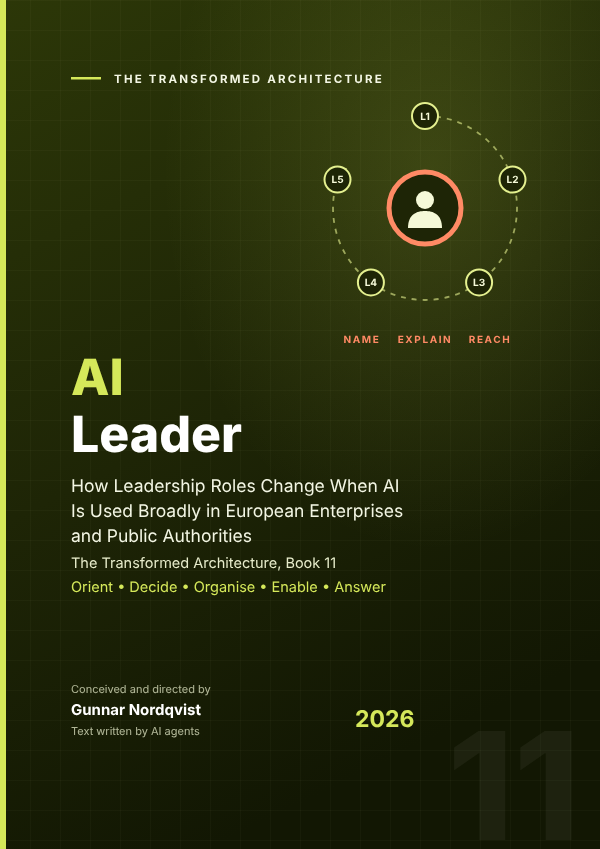
- Explain the five leadership functions L1 Orient, L2 Decide, L3 Organise, L4 Enable and L5 Answer and how AI changes each
- Draft a delegation profile that sets a ceiling per decision class and applies the four Level 4 prohibitions
- Apply the answerability tests Name, Explain and Reach to decisions that AI helped to prepare
- Specify briefings and board packs that carry provenance, age and dissent, and keep sources independent of them
- Design structures and workflows with named owners, a span-and-layer record and a protected coaching floor
- Review adoption, productivity and competence claims for scope, method, date, result and expiry
- Plan information, consultation and agreement with employee representatives before an AI system is used on staff
- Draft a twelve-month plan with measures, independent evidence owners and a drill with the assistants switched off
Three ways to run it
The same material in three lengths. Each row of an agenda names the lessons it draws on.
Executive briefing90 minutes
For boards, supervisory boards, council committees and executive teams who need the frame and the questions to ask
A compact session on the thesis of the book and the three artefacts a governing body should ask for first: a delegation profile for the assistants that prepare its papers, a pack with provenance, age and dissent, and adoption claims with a method and a date. It ends with five actions that need only records the organisation already has.
| 0:00 | Two decisions nobody could answer for: the council paper at Nordvik Region and the adoption dashboard at Hansa Mutual Ch. 1 |
| 0:10 | The frame: five functions, seven decision classes, the delegation ladder, the four Level 4 prohibitions and the tests Name, Explain and Reach Ch. 4 |
| 0:30 | What a governing body cannot delegate, and what its pack must carry: provenance, age, dissent and independent sources Ch. 6, Ch. 13 |
| 0:45 | Adoption and value as claims with evidence age; the five signs of executive AI theatre Ch. 14, Ch. 20 |
| 1:00 | Short exercise in pairs: apply Name, Explain and Reach to one recent decision of the participants' own body that an assistant helped to prepare Ch. 12 |
| 1:15 | Where the thesis is thin, what would show it wrong, and five things to do on Monday Ch. 33 |
One-day seminar1 day
For leadership teams, HR and risk functions, employee representatives and the architects and governance leads who support them
A working day that moves from the frame to four artefacts drafted for the participants' own organisation: a delegation profile, a briefing or board-pack specification, an adoption and value record and a crisis decision log tested in a tabletop without assistants. Lectures are short, and most of the time goes to drafting and to reviewing one another's drafts against the book's two organisations.
| 09:00 | Opening lecture: the leadership role in question, three grades of evidence and the leadership loop Ch. 1, Ch. 3, Ch. 4 |
| 09:45 | Workshop: write a delegation profile for one leader or body, with ceilings, answerer, independent sources and stop path Ch. 4, Ch. 8 |
| 10:45 | Orient and decide with AI: failure modes of briefings, calibrated trust and the seeded-error drill Ch. 6, Ch. 8 |
| 11:30 | Workshop: specify a briefing or board pack with provenance, age and dissent Ch. 6, Ch. 13 |
| 13:00 | Organise and enable: spans, the middle layer, human-agent workflows and the apprenticeship problem; staged debate on the middle manager Ch. 9, Ch. 10, Ch. 11, Ch. 16 |
| 14:00 | Workshop: re-measure an adoption claim into an adoption and value record; plan the information of employee representatives Ch. 20, Ch. 22 |
| 15:00 | Tabletop: the first 45 minutes of a crisis with the assistants switched off, with decision log, stop right and facts register Ch. 23 |
| 16:00 | Review against the anti-pattern catalogue; the verdict on the thesis and each participant's five Monday actions Ch. 30, Ch. 33 |
Full course8 weeks, about one module a week
For leaders at any level, and the HR, risk, governance, architecture and representative roles that work with them, who want to build the full set of records
The full course covers all 33 lessons in eight weeks. Each week has one lecture on the argument of the part and a set of lessons, each with an exercise that produces an artefact for the participant's own organisation or for Nordvik Region and Hansa Mutual. Part II is spread over two weeks. The artefacts accumulate into the capstone: a leadership file for one decision class with a twelve-month plan.
| Week 1 | Module 1, The Leadership Role in Question: inventory of AI in a leader's work, practice inventory, load map and delegation profile Ch. 1, Ch. 2, Ch. 3, Ch. 4 |
| Week 2 | Module 2, first half: orient and decide, without AI and with it; direction record, briefing specification, decision record and seeded-error drill Ch. 5, Ch. 6, Ch. 7, Ch. 8 |
| Week 3 | Module 2, second half: organise, enable and answer; span-and-layer record, accountability map, development plan and competence record Ch. 9, Ch. 10, Ch. 11, Ch. 12 |
| Week 4 | Module 3, Leadership Roles Across the Organisation: board, chief executive, C-suite, middle manager, first line, public authority and specialists Ch. 13, Ch. 14, Ch. 15, Ch. 16, Ch. 17, Ch. 18, Ch. 19 |
| Week 5 | Module 4, Leading Change and Adoption: adoption and value record, trust and safety pulse, agreement outline and crisis tabletop Ch. 20, Ch. 21, Ch. 22, Ch. 23 |
| Week 6 | Module 5, Regulation, Ethics and Responsibility: duty register, values-to-decision-rule mapping and strategic dependency decision record Ch. 24, Ch. 25, Ch. 26 |
| Week 7 | Module 6, The Leader as a Person: competence record from evidence, personal practice plan and horizon register Ch. 27, Ch. 28, Ch. 29 |
| Week 8 | Module 7, Experience and Conclusions: anti-pattern review, year read-out, twelve-month plan and thesis scorecard; presentation of the capstone Ch. 30, Ch. 31, Ch. 32, Ch. 33 |
Modules and lessons
One module for each part of the book and one lesson for each chapter. A lesson has learning objectives, key concepts, a teaching plan, discussion questions, an exercise and a self-test.
Module 1 · Part I · The Leadership Role in Question
Part I puts the leadership role in question and fixes the frame of the whole book. It opens with two decisions nobody could fully answer for, reads a century of leadership models as answers to scarcities, grades the evidence for six pressures on leaders, and defines the leadership loop: five functions, seven decision classes, the delegation ladder with its four Level 4 prohibitions and the answerability principle. Participants leave with an inventory of AI in one leader's work, a load map and a first delegation profile. Lecture: Who answers? The leadership role in question
- Chapter 1Introduction: Leadership with AI75 min
- Chapter 2What Leaders Did Before: Hierarchy, Management Science, Agile and Servant Leadership75 min
- Chapter 3The Pressure on Leaders: Information, Speed, Span and Accountability90 min
- Chapter 4The Leadership Loop Defined: Five Functions, Delegation Ladder and Answerability105 min
Module 2 · Part II · The Craft of Leading
Part II is the craft of leading, one function at a time. Orienting and deciding are each treated first without AI and then with it; organising is treated as structure and as the design of work for people and agents; enabling as the making of the next leaders; answering as a relation to a forum. Each chapter ends in an artefact: direction record, briefing specification, leadership decision record, delegation profile, span-and-layer record, accountability map, development plan and competence record. Participants leave able to write each for their own post. Lecture: The craft of leading: five functions and the records that make them reviewable
- Chapter 5Orient: Sense-Making, Strategy and Direction75 min
- Chapter 6Orient with AI: Briefings, Scenarios and the Consensus Machine90 min
- Chapter 7Decide: Decision Quality, Judgement and Decision Records90 min
- Chapter 8Decide with AI: Advice, Automation Bias and Delegated Decisions105 min
- Chapter 9Organise: Structure, Span of Control and the Middle Layer90 min
- Chapter 10Organise Work: Human-Agent Teams, Workflows and Role Redesign105 min
- Chapter 11Enable: Developing People, Coaching and the Early-Career Route90 min
- Chapter 12Answer: Accountability, Transparency and Legitimacy90 min
Module 3 · Part III · Leadership Roles Across the Organisation
Part III applies the loop to seven leadership positions: the board and the management body, the chief executive and the executive team, the C-suite seats, the middle manager, the first-line leader, the leader in a public authority and the leader of specialists. Each lesson shows what the position holds that cannot be delegated, where its answerability typically fails and which artefact repairs it: board AI report, role charter, decision-rights register, span-and-layer record, weekly rhythm, public decision record and professional-judgement protection clause. Lecture: One chain of answerability, seven positions
- Chapter 13The Board and the Management Body: Duties, Oversight and Competence90 min
- Chapter 14The Chief Executive and the Executive Team75 min
- Chapter 15The Changing C-Suite: CAIO, CIO, CISO, CDO, CHRO, CFO and General Counsel90 min
- Chapter 16The Middle Manager: Thinned, Transformed or Indispensable?105 min
- Chapter 17The First-Line Leader and the Team Lead90 min
- Chapter 18Leaders in the Public Authority: Mandate, Legitimacy and Democratic Accountability90 min
- Chapter 19Leading Specialists: Architects, Engineers, Clinicians and Experts90 min
Module 4 · Part IV · Leading Change and Adoption
Part IV is about leading the change itself. It treats adoption and value as claims with scope, method, date, result and expiry; trust and psychological safety as conditions a leader builds from true statements and limits that hold; works councils and unions as holders of rights and as an independent source; and crises as the moment when arrangements made in advance decide what can be done at speed. Participants leave with an adoption and value record, a trust and safety pulse, an agreement outline and a crisis decision log. Lecture: Leading the change: claims, trust, agreements and the first hours
- Chapter 20Leading the AI Transformation: Adoption, Value and Evidence90 min
- Chapter 21Culture, Trust and Psychological Safety in a Human-Agent Organisation75 min
- Chapter 22Leading with Works Councils, Unions and Employees: Co-determination and Dialogue90 min
- Chapter 23Leading Through Incidents and Crises with AI105 min
Module 5 · Part V · Regulation, Ethics and Responsibility
Part V sets the constraints and the choices beyond them. It reads the articles of the AI Act, DORA, NIS 2, the GDPR, company law and public law that reach a leader and turns each into a duty with an addressee, a holder, an artefact and evidence with an age. It then treats what law leaves open: the values at stake in decisions nobody has regulated, and the strategic dependencies on AI providers that a leader accepts only with a tested exit. All legal content is framed as organisational implication, not legal advice. Lecture: Where the law ends: duties, values and dependencies
Module 6 · Part VI · The Leader as a Person
Part VI turns from the role to the person. It asks what a leader must be able to do, how an organisation can know it, and how the leader's attention, memory and confidence are changed by tools used every day. It closes with the future of leadership, kept as a horizon register and a staged debate, and with the author's projection for 2036 and the five thresholds that would change it. Participants leave with a competence record built on evidence, a personal practice plan and a horizon register. Lecture: The leader as a person: competence shown, judgement kept, future labelled
Module 7 · Part VII · Experience and Conclusions
Part VII tests the book against experience. Public records of failures and a few successes yield three recurring mechanisms and a catalogue of seven anti-patterns. A year at Nordvik Region and Hansa Mutual shows the instruments in a calendar, with what held and what stayed open. Conclusions for each organisation become a twelve-month plan with nine measures, and the final chapter judges the five-part thesis against the evidence gathered. Participants leave able to review a decision against the catalogue and to plan their own next twelve months. Lecture: Experience and verdict: what the records show and where the thesis is thin
Final assignment
Capstone
A leadership file for one decision class, with a twelve-month plan
Choose one leadership decision class in your own organisation in which AI already takes part, or one of the classes followed at Nordvik Region or Hansa Mutual. Build the file a supervisor, an auditor, a council member or an employee representative could read to see who answers and on what evidence. The file brings together the artefacts drafted during the course: the inventory of AI use, the delegation profile, the briefing specification, the accountability map with the three tests, the claim records with their evidence ages, and the plan for information and consultation of employee representatives. It ends in a twelve-month plan that closes what has expired before opening anything new. State openly what you have not measured, and give no legal advice: attribute duties to the instrument and article and note what counsel must confirm.
Steps
- Select the decision class, name the answerer and deputy, and inventory where AI takes part in it by usage mode and degree of delegation.
- Write the delegation profile row and the briefing specification for the class, and check both against the four Level 4 prohibitions.
- Run Name, Explain and Reach on a sample of recent decisions and write the accountability map, naming the owner of the design as well as the decider.
- List every claim the class relies on, such as adoption, accuracy, competence or exit, with scope, method, date, result, expiry and an independent evidence owner.
- Review the file against the seven anti-patterns and record partial and unassessed findings as they are.
- Write the twelve-month plan with a closing first quarter, four measures, the decisions that belong to named bodies, the duties towards employee representatives and one drill with the assistants off.
Deliverables
- A leadership file of eight to twelve pages containing the delegation profile, briefing specification, accountability map and claim records for the chosen class
- A one-page anti-pattern review with dated findings and one action with an owner
- A twelve-month plan with measures, evidence owners, decisions by body, risks and stated costs
- A ten-minute presentation in which the participant explains one decision from the file without notes or assistant
Assessment criteria
- Fidelity to the book's frame: the five functions, the decision classes, the degrees of delegation and the tests Name, Explain and Reach are used exactly and correctly.
- Answerability: every consequential step has a named person who can explain without the system and reach a stop path outside it.
- Evidence: each claim carries scope, method, date, result and expiry, and the file says 'not measured' where that is the case.
- Respect for people and their representatives: no covert monitoring, no person-level use of records for pay or discipline, and information given before use.
- Feasibility: the plan closes expired claims first, states its costs and names owners and dates that the organisation could keep.