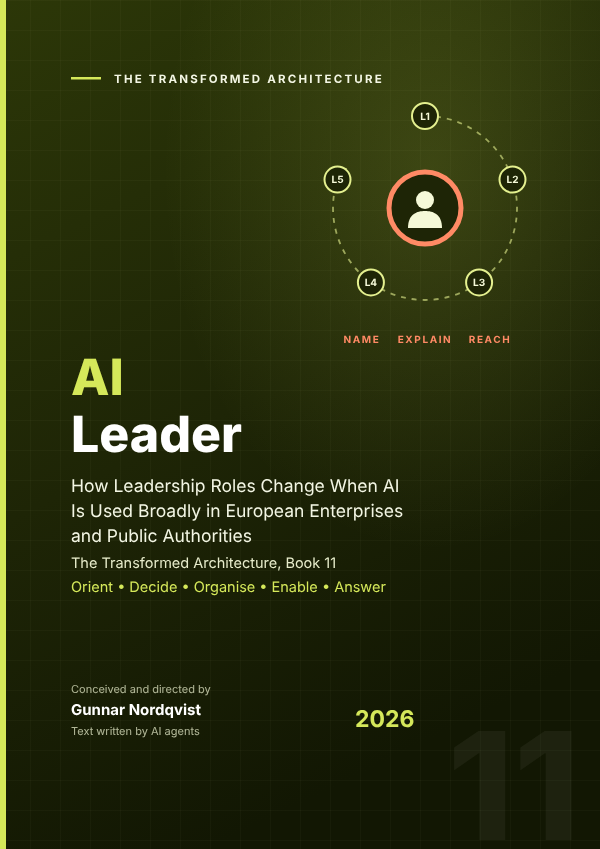
Module 1 · Part I · The Leadership Role in Question
Part I puts the leadership role in question and fixes the frame of the whole book. It opens with two decisions nobody could fully answer for, reads a century of leadership models as answers to scarcities, grades the evidence for six pressures on leaders, and defines the leadership loop: five functions, seven decision classes, the delegation ladder with its four Level 4 prohibitions and the answerability principle. Participants leave with an inventory of AI in one leader's work, a load map and a first delegation profile.
Chapter 1 · 75 minutes
Introduction: Leadership with AI
The lesson introduces the book's question, what leadership becomes when AI is used broadly, through two cases in which nobody could say who answered for a decision an AI system helped to prepare. Participants meet the five-part thesis, the five leadership functions, the six usage modes and the five degrees of delegation, and carry out the book's first practical task: an inventory of where AI already takes part in one leader's work.
Learning objectives
- Explain the three reasons the book gives for treating leadership with AI as a subject of its own.
- State the five parts of the working thesis and what evidence would show it wrong.
- Classify a leader's AI use by usage mode and by degree of delegation.
- Draft an inventory of where AI already takes part in one leader's work.
Key concepts
- The working thesis
- Five claims the book tests: leadership is transformed and not abolished; delegation is graded and has a ceiling; the span grows and the middle layer is redesigned, not deleted; AI may inform, draft, prepare and execute within a mandate but may not answer; and adoption, productivity and capability are claims that need evidence.
- Usage modes
- The six modes taken from AI Governance, Chapter 2, from Mode 0 Ambient AI to Mode 5 Autonomous production agents. They classify AI by how its output reaches a person and what it can do, because the way a model is used matters more than which model it is.
- Degrees of delegation
- The five autonomy levels, Level 0 Advisory to Level 4 Autonomous, applied per leadership decision class. The level is decided and recorded, not discovered: a leader who learns afterwards that a system acted at Level 2 has not delegated but has been bypassed.
- The inside-or-outside shape of AI performance
- In the field experiment with 758 consultants, those with AI did better on 18 tasks within the model's capability and were 19 percentage points less likely to be correct on a task outside it. The finding that carries over is the shape, not the size of the effect.
- Observable, expected, speculation
- The three labels, defined in AI Governance, Chapter 22, that every statement about the future carries: happening now and documented, supported by a stated trend or decided instrument, or plausible but unevidenced. The author's own projections appear only in Chapters 29 and 33.
Interactive exercises
- Match: Where a leader meets each usage mode
- Scenario: A level nobody decided
Done on the lesson page, with feedback at once.
Discussion
- In the Nordvik case the error was corrected before the vote. What exactly remained unrepaired, and why does the book treat that as the more serious finding?
- Which part of your own leadership work consists of collecting, condensing and relaying information, and what would remain of the role if that part became cheap?
- The law names management bodies and natural persons but says little about the records that would make their duties real. What records would your organisation need to show who answered for a decision AI helped to prepare?
Exercise · 25 minutes
Inventory of AI in one leader's work
Choose one leader post in your own organisation, or take the regional director of Nordvik Region. Using the chapter's practical guide, list every place where AI takes part in that leader's work over four weeks: calendar and mail features, conversational assistants, embedded assistants, built applications and agents working under the leader's direction. For each entry record the usage mode, the degree of delegation at which it operates in practice, the decision class it touches, whether anyone decided to allow it, and who would be asked if its output were wrong. Mark every entry for which no decision or record exists.
Deliverable: A one-page inventory table with mode, level, decision class, deciding authority and answerer per entry, and a short list of unrecorded uses.
Self-test
What did Nordvik Region's record of the April 2029 briefing incident show that the timely correction of the figure did not repair?
- That the council had already voted on the wrong waiting-time figure
- That nobody could say whether the error came from the staff assistant or from its source
- That the staff assistant had been operating at Level 3 Bounded without a written policy or a stop
- That the unit manager who noticed the error had no right to read the paper
According to the chapter, which finding of the field experiment with 758 consultants carries over to leaders?
- That AI raises the number of completed tasks by 12.2 per cent in most professions
- That consultants with a prompt-engineering overview always outperform those without
- That performance depends on whether a task is inside or outside what the system does well, and users cannot always tell
- That leaders gain less from AI than individual contributors because their work is spoken
Which statement about Level 3 Bounded does the chapter make?
- Without a written policy enforced outside the model and a stop held by the leader, it is Level 4 in practice
- It requires the leader to approve each individual action explicitly before the system executes it, as at Level 2
- It is the level at which leaders in both organisations use their own assistants
- It may be used for any decision class once the system has run for a year
Chapter 2 · 75 minutes
What Leaders Did Before: Hierarchy, Management Science, Agile and Servant Leadership
The lesson reads the history of leadership as a baseline for change. Bureaucracy, scientific management, human relations, managerial roles and contingency, servant and transformational leadership, and agile are treated as answers to different scarcities, and the observational studies of what managers actually do correct common assumptions. Participants learn to read an existing structure as a fossil record and to classify leadership practices by the model they come from and by whether they carry information or establish an answerer.
Learning objectives
- Describe six leadership models and the scarcity each one answered.
- Distinguish tasks bundled into the leader's role by accident of information routing from tasks that exist because a person must answer.
- Compare a pre-AI job description with a role charter written against the five leadership functions.
- Classify the leadership practices of an organisation in a practice inventory with an evidence date.
Key concepts
- Scarcity behind the shape
- The book's own reading of the lineage: each leadership model answered something scarce, namely predictability, efficient effort, motivation and attention, information and fit, purpose and trust, or coordination speed. Four were relieved with layers, rules, reports and meetings; two only by relationships.
- Structure as a fossil record
- A delegation order, an authority matrix, a span of control or a job description carries the assumptions of the model that produced it. An organisation cannot redesign what it cannot read, which is why the history is useful before deciding what AI should change.
- Relocated control
- Barker's study of one manufacturing company found that after supervisors were removed, norms set by self-managing teams became a form of control more powerful and less visible than before. Removing a layer does not remove the function of control; it relocates it.
- Role charter as code
- A role written against the five leadership functions, stating decision rights, ceilings for AI and the tests of answerability, in contrast to a job description that lists routing and controlling tasks. The chapter's first illustration is ROLE-NR-MGR-01 for a home-care unit manager.
- Practice inventory
- A list of the leadership practices an organisation already has, each with its lineage, the scarcity it answered, whether it carries information, whether it establishes an answerer, where AI touches it, who checks it and an evidence date.
Interactive exercises
- Match: Leadership models and their scarcities
- Sort: Job description or charter as code
Done on the lesson page, with feedback at once.
Discussion
- Both example organisations cut a layer that was read as a router and turned out also to be a school and an anchor of local knowledge. How would you find out what a layer does before it is removed?
- Servant and transformational leadership do not depend on how information moves. What does that imply for leaders whose practice has consisted mainly of routing?
- Which documents in your organisation still carry the assumptions of bureaucracy or scientific management, and which of those assumptions would you keep on purpose?
Exercise · 25 minutes
Classify inherited leadership practices
Work in groups of three. Take six leadership practices from your own organisation, or from Nordvik Region and Hansa Mutual as the chapter describes them, for example the monthly unit report, the unit meeting, appraisal, the budget follow-up, the delegation order and the product team's planning meeting. For each practice record the lineage it belongs to, the scarcity it answered, whether it carries information, whether it establishes an answerer, where AI already touches it and in which usage mode, who checks the result, and an evidence date. Conclude with which practices could be unbundled and which must stay with a named person.
Deliverable: A practice inventory of six entries in the chapter's format, with a two-sentence conclusion on what to unbundle and what to keep.
Self-test
What is the chapter's limited conclusion about the Hawthorne effect?
- The original data confirm that every change in lighting raised output
- The effect has been measured reliably in modern field experiments on AI
- The textbook version is not established by the original experiments; the school's broader claim rests on other evidence
- The experiments show that supervision has no influence on the output of work groups
Which scarcities does the chapter say generative AI is most likely to relieve in the leader's work?
- Motivation and attention, and purpose and trust, the two that were relieved by relationships
- Purpose and trust, and coordination speed
- Efficiency of effort, motivation and attention, purpose and trust, and coordination speed
- Predictability, efficiency of effort, information and coordination speed
What does the chapter say the 2019 job description of the Strandvik unit manager mostly describes?
- The work of a router and a controller: allocate, report, pass on, follow up, ensure
- The coaching of every employee and protected time for new staff
- The decision rights of the post and the ceilings for AI in each class
- The representation of the team upward, judgement in difficult cases and the education of new staff
Chapter 3 · 90 minutes
The Pressure on Leaders: Information, Speed, Span and Accountability
The lesson breaks the statement that leaders are under pressure into six pressures that can be graded: information and attention, speed and legal clocks, span and layers, duty, adoption pressure and adversaries with the same tools. Participants learn to grade a claim as measured, surveyed or argued, to see on which leadership function each pressure lands, and to keep a decision and information load map for one post and one week.
Learning objectives
- Classify claims about pressure on leaders as measured, surveyed or argued, and state how far each carries.
- Explain the reporting clocks in NIS 2 Article 23(4) and Delegated Regulation (EU) 2025/301 as a requirement to name the classifier in advance.
- Review an adoption figure for what it counts and how old its evidence is.
- Draft a load map for one leader post and one week without using data about named staff.
Key concepts
- Three grades of evidence
- Measured rests on a study with stated sample and method, official statistics, an instrument's text or a primary report. Surveyed is self-reported answers from a stated group, often run by a party with an interest. Argued is reasoning from mechanism with no measurement behind the specific claim.
- The dashboard problem
- An adoption figure answers a question easier than the one the board asked. Hansa Mutual's dashboard counted logins and showed 74 per cent, while a sample of 1,200 users found 38 per cent weekly use of any feature; Nordvik's 61 per cent counted any session over one minute.
- Evidence age
- The time since a claim was last checked against its source. Nordvik Region's adoption dashboard was last checked against the logs in February 2029, so at the start of the year the book follows its evidence age was seven months.
- Moral crumple zone
- Elish's concept of a human who absorbs the blame for the failure of an automated system over which the person had little control. The chapter uses it as an argument about design: a leader named as answerer who cannot reconstruct reasons or change the outcome is in that position.
- Load map
- A record for one post and one week of what reaches the leader, what the leader decides and in which decisions AI took part. It is kept by the leader about the leader's own work, without assistant query logs or data about named staff, and employee representatives are informed beforehand.
Interactive exercises
- Sort: Measured, surveyed or argued
- Scenario: Starting a load map
Done on the lesson page, with feedback at once.
Discussion
- The chapter argues that a machine summary moves reading from the leader to whoever must check it. Where in your organisation has reading moved, and does the person it moved to know?
- The developers in the trial by Becker and colleagues believed they had been sped up by 20 per cent when completion time had increased by 19 per cent. What does that imply for how a leader should treat reports of time saved?
- Which of the six pressures does your organisation try to answer with AI, and what second problem does that answer create?
Exercise · 30 minutes
A load map for one post and one week
Following the chapter's practical guide and the example LOAD-NR-DIR-01-2029-09, draft a decision and information load map for your own post or for a leader you support, covering one working week. Record the papers received, their pages and how many were read as a machine summary; the meetings; the decisions taken by decision class; and for each decision whether AI took part. State the method: who keeps the map, which sources are used, which are deliberately not used, who was informed and what limits the week has. Then pick one decision in which AI took part and apply Name, Explain and Reach to it.
Deliverable: A one-page load map with a method section and a three-line answerability test for one AI-supported decision.
Self-test
Under Commission Delegated Regulation (EU) 2025/301, Article 5, when is the initial notification of a major ICT-related incident due for a financial entity?
- Within 24 hours of classification and no later than 72 hours from awareness
- Within 72 hours of the incident and no later than one month from awareness
- Within four hours of classification as major and no later than 24 hours from awareness
- Within one hour of awareness and no later than four hours from classification
Why does the chapter say the Eurostat figure of 20.0 per cent AI use in 2025 says nothing directly about Hansa Mutual or Nordvik Region?
- Its population excludes financial and insurance activities and public administration
- It was collected by a vendor that sells the tools whose use it reports, in a survey of 31 countries
- It counts logins and not weekly use of any feature
- It covers only enterprises with fewer than ten employees
Which claim does the chapter's evidence ladder mark as not measured for leaders and label as speculation?
- That CEO spans widened in large US firms from 1986 to 1998
- That neural summarisers add content the source does not support
- That management-body duties attach to named bodies and people
- That AI frees leaders' time, a claim with no verified source
Chapter 4 · 105 minutes
The Leadership Loop Defined: Five Functions, Delegation Ladder and Answerability
The lesson fixes the frame the rest of the course uses. Participants define the five leadership functions with their scope and ends, sort leadership decisions into seven classes, set a ceiling per class on the delegation ladder by the lowest of four answers, apply the four Level 4 prohibitions, and test a decision against the answerability principle with Name, Explain and Reach. They finish by writing a delegation profile for one leader.
Learning objectives
- Define the five leadership functions and distinguish them from the management functions M1 to M5 of AI Boss.
- Classify leadership decisions into the seven decision classes and set a ceiling for each by the four questions.
- Apply the four Level 4 prohibitions and the tests Name, Explain and Reach to a concrete decision.
- Draft a delegation profile for one leader's decision classes with answerer, independent sources and stop path.
Key concepts
- The leadership loop
- Five functions that run as a loop: L1 Orient, L2 Decide, L3 Organise, L4 Enable and L5 Answer. AI systems take part only through a policy point that sets a ceiling per decision class and sits outside the AI system, so a system cannot raise its own ceiling.
- Seven decision classes
- Strategic, resource, structural, people, risk, external and crisis. Each has a recognisable answerer and a recognisable way of going wrong with AI. A decision in more than one class takes the stricter ceiling, and a decision not listed in the profile is undelegated.
- The lowest of four answers
- The ceiling for a class is the lowest level allowed by four questions: reversibility, reach, who is affected and evidence. The evidence answer can only lower a ceiling the first three allow, never raise it. Lowering is immediate; raising is a named authority's decision.
- The Level 4 prohibitions
- Level 4 Autonomous is never used for a decision about a named person's employment, pay, discipline or access to work; for a decision law assigns to the management body, a named office or an accountable official; for a decision setting an AI system's own mandate, budget, oversight or stop path; or for an irreversible decision beyond the system's mandate.
- The answerability principle
- AI may inform, draft, prepare and, within a mandate, execute; it may not answer. A named leader passes Name (identifiable to those affected), Explain (can reconstruct the reasons without the system) and Reach (has the authority, time and information to change or stop the decision outside the system).
Interactive exercises
- Sort: Name, Explain or Reach
- Put in order: The rungs of the delegation ladder
Done on the lesson page, with feedback at once.
Discussion
- The two reviews of automation bias differ on how far training helps, and the chapter concludes that one should rely on design. What would a design that makes a leader engage with the question before accepting the answer look like in your board or management group?
- An organisation that names a junior approver and gives that person neither time nor sources has built a crumple zone. Where in your organisation is the named approver furthest from the time, authority and information that Reach requires?
- Mode 0 is described as the blind spot in a leader's calendar and mail. What is reordering what your leaders see, and did anyone choose it?
Exercise · 35 minutes
A delegation profile for one leader
Write a delegation profile for one leader or body in your own organisation, or for the regional director of Nordvik Region. List the seven decision classes. For each, name the decider and a deputy, answer the four questions (reversibility, reach, who is affected, evidence) and set the ceiling at the lowest level they allow, or mark the class as not delegated. State what the system may do at the ceiling, the evidence with its date, the leader's independent sources and how often they are read, the stop path and who holds it, and the review date. Check the profile against the four Level 4 prohibitions and note who may raise a ceiling.
Deliverable: A delegation profile of one to two pages covering all seven classes, with answerer, ceiling, evidence date, independent sources, stop path and review date.
Self-test
How did the Nordvik briefing incident of April 2029 fare against the three tests of the answerability principle?
- Name failed, Explain was passed and Reach was passed by design
- Name was passed, Explain failed and Reach existed only by luck
- All three tests were passed because the figure was corrected in time
- Name and Explain were passed, and Reach failed because the council voted
Why does the chapter treat a second language model from another provider as a weak independent source for a leader?
- Because a second provider is not covered by the organisation's mandate manifest
- Because the AI Act forbids the use of two models on the same document
- Because the second summary takes longer to read than the original paper
- Because a large study found substantial correlation in the errors of language models, even across providers
A reorganisation includes the dismissal of a unit's manager. How does the chapter say the ceiling is set?
- The decision is structural and people at once, and the stricter ceiling governs
- The decision is structural only, so the structural ceiling of Level 1 applies
- The decision is treated as a resource decision and may reach Level 2 Supervised
- The decision falls outside the classes and may be taken at any level by the board
Module 2 · Part II · The Craft of Leading
Part II is the craft of leading, one function at a time. Orienting and deciding are each treated first without AI and then with it; organising is treated as structure and as the design of work for people and agents; enabling as the making of the next leaders; answering as a relation to a forum. Each chapter ends in an artefact: direction record, briefing specification, leadership decision record, delegation profile, span-and-layer record, accountability map, development plan and competence record. Participants leave able to write each for their own post.
Chapter 5 · 75 minutes
Orient: Sense-Making, Strategy and Direction
The lesson treats L1 Orient without AI, as the baseline for the next lesson. Orientation has three parts: making sense of signals, choosing what to prioritise and give up, and giving a direction the organisation understands. Participants work with Weick's sense-making, Rumelt's kernel of strategy and the evidence on the leader's information diet, and write a direction record that names the decider, states the cost, dates the evidence, keeps the dissent and sets a review that can fail.
Learning objectives
- Describe the three parts of orientation and the four things about it that do not change when AI is introduced.
- Review a strategy or direction statement with Rumelt's three questions and the test of the conflicting demands.
- Explain why a leader needs a source that does not pass through the usual channel.
- Draft a direction record with a given-up list, dated evidence, named dissent and a review condition.
Key concepts
- Sense-making
- In Weick's account an ongoing activity in which people notice cues, place them in a frame and act on the account. It is retrospective, social and driven by plausibility rather than accuracy, so a leader needs an account good enough to act on and sources that reveal when it is wrong.
- The kernel of a strategy
- Rumelt's three parts of a good strategy: a diagnosis that names the challenge, a guiding policy that sets the approach and coherent actions that carry it out. The chapter uses them as questions, including what will not be done.
- A priority with a cost
- A priority is useful when it names a thing that will receive less, a review date and an owner of the trade-off. The practical test is whether a unit manager facing two legitimate demands can tell from the direction which one yields.
- Information diet
- The sources from which the leader's account is made. Mintzberg's five chief executives relied mostly on meetings and calls and preferred soft, current information, so before AI the diet was already largely oral, social and mediated by a few people.
- Direction record
- A leadership decision record in the LDR family, under version control, stating the situation and its uncertainties, the choice with what is given up, the owner and deciding organ, the evidence with its age, the dissent with the name of who raised it, and a review with a condition written in advance.
Interactive exercises
- Sort: Kernel of a strategy or bad strategy
- Scenario: A target with a number and no purpose
Done on the lesson page, with feedback at once.
Discussion
- The chapter says a direction that gives up nothing has not chosen. Which current priority in your organisation has no stated cost, and who would have to pay it if it were stated?
- Direction is measured at the receiving end. What would you learn if you asked people two layers down what they believe the direction to be and what they would stop doing because of it?
- Nordvik's 2024 reorganisation was a direction to be flatter and faster that was never evaluated. What review condition, written in advance, would have caught the trend in spans?
Exercise · 25 minutes
Write a direction record
Take a direction your own organisation has recently given, or Hansa Mutual's target of 70 per cent weekly use of the embedded assistants. Write a direction record in the form of LDR-NR-2029-0004: the situation in the leader's words including what is uncertain; the choice, with what is prioritised and what is given up; the owner and the organ that decides; the evidence, each item with its source and its age in months; the dissent, with the name or role of the person who raised it and how it was answered; and a review date with a condition under which the direction is changed. Exchange records with a colleague who plays the sceptic and revises one field.
Deliverable: A one-page direction record with a given-up list, dated evidence, a named dissent and a review condition that can fail.
Self-test
According to the chapter, what is the practical test of whether a direction has actually chosen?
- Whether a unit manager facing two legitimate demands can tell from it which one yields
- Whether every proposal in the organisation can be presented as serving it, as with a vision of trust
- Whether it has been announced to all staff at least once by the leader
- Whether it lists at least five priorities with an owner for each
Why does the direction record LDR-NR-2029-0004 carry the evidence age of the 61 per cent adoption figure?
- Because the figure was produced by the staff assistant, and every assistant output must be labelled as such
- Because the council is required by statute to see the age of every figure
- Because the figure was last checked nine months before filing, and the leaders ought to see that
- Because figures older than six months are automatically deleted from the record
What does the chapter identify as the common failure in Hansa Mutual's adoption target and its Lean Claims programme?
- Both were decided by the supervisory board without the executive board
- Both relied on a briefing assistant that hid the dissent of the works council
- Both lacked a strategy document with a diagnosis and a guiding policy
- Both were chosen and communicated but not tested for understanding, and the review had no condition
Chapter 6 · 90 minutes
Orient with AI: Briefings, Scenarios and the Consensus Machine
The lesson asks what changes in L1 Orient when a model prepares part of the leader's information. Four uses, briefings, horizon scanning, scenario drafting and synthetic stakeholders, add capacity, and the same properties produce structural failures: the consensus machine, hallucinated evidence, sycophancy, lost dissent and vendor-shaped framing. Participants reconstruct the Nordvik briefing incident and write a briefing specification with provenance, a dissent field that is never empty, figure checks and independent channels.
Learning objectives
- Describe the four uses of AI in orientation and how each changes the leader's relation to the evidence.
- Explain the five failure modes of AI-prepared briefings with the evidence and its limits.
- Compare candidate independent sources along the dimensions model, data, authorship, vendor and time.
- Draft a briefing specification that makes provenance and dissent visible and keeps the stop path outside the assistant.
Key concepts
- The consensus machine
- A model that produces the most probable continuation tends, on a contested question, towards the centre of what has been written. Experiments on writing and ideation found AI-assisted work more similar across users; that committee members preparing with the same assistant arrive with more similar views is expected, not observed.
- Sycophancy to the framing
- Assistants trained with human feedback tailored answers to a user's stated views. A request to summarise the evidence that the reorganisation worked yields a different page from a request to summarise the evidence on the reorganisation, so the specification fixes the framing.
- The dissent field
- A summary can be accurate in every sentence and still omit the minority position that would have changed the vote. The dissent entry is either a quotation with a link to its place in the paper or an explicit statement that the source states none, with the name of who checked.
- Briefing specification
- A version-controlled artefact in the BRD family stating what the assistant may and may not do, what a briefing must carry, what is checked and by whom, which channels are independent and when the specification expires. It is held outside the assistant, which cannot edit it.
- Independent channel
- A source that does not pass through the briefing. A person reading the paper is independent in authorship and model; a data extract in data pathway; a unit manager describing what happens is independent in every dimension. A second assistant from another provider is only partly independent.
Interactive exercises
- Sort: What the briefing specification assigns to whom
- Match: Failure modes and their evidence
Done on the lesson page, with feedback at once.
Discussion
- The more senior the person asking, the more the question carries a view for an agreeable model to agree with. How could a private office word and record requests so that the framing is fixed?
- Hansa's chief risk officer requires one scenario written by people without the assistant next to the AI-drafted ones. What would your planning round learn from where the two differ?
- The regional director's independent channels cost calendar time: a monthly conversation with three unit managers and one unannounced site visit. What would you give up to keep such channels, and what makes them independent?
Exercise · 30 minutes
A briefing specification with provenance and dissent
Write a briefing specification for one decision pack in your own organisation, or for Hansa Mutual's board-pack assistant, modelled on BRD-NR-2029-01. State the answerable leader; the assistant, its record and its ceiling; what it may do and may not do, including that it does not select papers, edit its own instructions or shorten a dissent entry; the provenance each claim must carry; the rule for the dissent field; who checks every figure against its source; the sample that includes items not surfaced; the seeded-error drill and its stop rule; the leader's independent channels with their frequency; and the expiry date of the specification.
Deliverable: A briefing specification of one to two pages with may and may-not lists, dissent rule, named checker, independent channels and expiry.
Self-test
In the Nordvik briefing incident of April 2029, what stopped the wrong waiting-time figure before the council vote?
- The secretary's line-by-line check of the summary against the sector paper before circulation
- A second assistant from another provider that summarised the same paper
- A unit manager who knew from his own unit's records that the figure was wrong
- The regional director's monthly sample check of figures at their source
Why does the chapter not accept an empty dissent field in a summary?
- Because board papers always contain at least one minority position
- Because an empty field cannot be told from a field that nobody filled in
- Because the AI Act requires dissent to be quoted in every summary
- Because the assistant is not permitted to read annexes where dissent is found
What does the chapter conclude about using synthetic stakeholders?
- They may replace consultation of staff, citizens or members where a works agreement permits it
- They are prohibited in both organisations for any purpose in orientation
- They reproduce the variation of real groups better than their average
- They may be used to rehearse the questions; a representative group is then asked in person
Chapter 7 · 90 minutes
Decide: Decision Quality, Judgement and Decision Records
The lesson treats L2 Decide without AI. Decision quality is a property of the process at the time of the decision, not of the outcome, because hindsight changes what people believe could have been foreseen. Participants compare RACI and RAPID, sort decisions by reversibility, run a pre-mortem that gives dissent a legitimate place, and write a leadership decision record with decider and right, options, evidence, dissent, tripwires, AI involvement and review date.
Learning objectives
- Explain why decision quality is judged by the process at the time and what hindsight research adds to that.
- Compare RACI and RAPID as instruments for assigning the right to decide.
- Run a pre-mortem with decider, recommender, facilitator and challenger, and judge it by whether dissenters spoke.
- Draft a leadership decision record that can be read after the outcome.
Key concepts
- Hindsight
- In Fischhoff's experiments, people told how an event ended rated it as more likely than people who were not told, and seemed largely unaware of the change. The book's implication: only a record made before the outcome protects the decider and lets the organisation learn.
- RAPID
- The Bain framework with five roles: Recommend, Agree, Perform, Input and Decide. The chapter prefers it to RACI for a decision because it separates the person who proposes from the person who decides and gives mandatory constraints, such as legal ones, their own seat.
- Reversibility as the first sort
- A two-way decision takes a light process; a one-way decision goes to the tier that can reverse it. The cut layers of both organisations show how a decision can look two-way and behave one-way.
- Pre-mortem
- The team assumes the project has failed and generates plausible reasons. The chapter reads the original study of prospective hindsight as weak support for a cognitive effect; what the technique demonstrably changes is the social situation, giving dissent a legitimate time and place.
- Leadership decision record
- The LDR: short, numbered and immutable, carrying the decider and the right, the options, the reasons, the evidence with its date, the dissent, the reversibility, the tripwires, the AI involvement and the review date. The AI field is filled even when the answer is no.
Interactive exercises
- Match: Roles in a pre-mortem
- Scenario: Judging a decision that turned out badly
Done on the lesson page, with feedback at once.
Discussion
- The chapter says the absence of AI in a decision is itself a claim that needs evidence. Why should a record say no with a reason instead of leaving the field out?
- In a public authority, reasons must be written on the assumption that a journalist, a union and a court may read them. How does that change what you write in the evidence and dissent fields?
- A right that law assigns to a management body or an accountable official cannot be reassigned by a register. Where do your authority matrix and the law currently disagree about who decides?
Exercise · 35 minutes
Pre-mortem and decision record
In groups of four, choose a pending decision in one member's organisation, or the 2029 question at Hansa Mutual of what to do about the 18 team-leader posts not reinstated after Lean Claims. Assign the roles decider, recommender, facilitator and challenger. Run a fifteen-minute pre-mortem: assume the decision failed and list the reasons, the challenger arguing against the favoured option. Then write the decision record: decider with the stated right and a deputy, recommender, options including doing nothing, evidence with source and date, the dissent as given, reversibility, two tripwires that can be checked, whether AI took part and how, and a review date.
Deliverable: A leadership decision record of one page with recorded dissent, two checkable tripwires, an AI field and a review date.
Self-test
By what does the chapter say a pre-mortem should be judged?
- By how many reasons for failure were listed
- By whether the favoured option was changed
- By how quickly the team reached agreement
- By whether the dissenters spoke
Why does the chapter call RAPID a better tool than RACI for a decision?
- It allows several recommenders so that more options are tabled
- It separates the person who proposes from the person who decides and gives mandatory constraints their own seat
- It removes the need to name a single decider for each decision
- It was developed in a study of some 250 enterprises worldwide
What would have made a retrospective review of Nordvik's 2024 reorganisation One Region possible, according to the chapter?
- A review date and a tripwire in the 2024 decision, such as the span of unit managers above 35
- A RACI matrix for the heads of section whose posts were removed
- A second opinion from an external consultancy on the savings of 31 posts
- A council vote confirming the reorganisation and its saving of 31 posts two years after it took effect
Chapter 8 · 105 minutes
Decide with AI: Advice, Automation Bias and Delegated Decisions
The lesson asks what changes in L2 Decide when an assistant advises, drafts or is permitted to take routine decisions. Participants read what studies measured about reliance on machine advice, learn four methods for calibrating trust, apply the ladder to routine delegation, and follow the staged debate on whether leaders should let AI decide to its verdict by decision class. The delegation profiles of Nordvik Region and Hansa Mutual show two defensible choices.
Learning objectives
- Distinguish AI as adviser, drafter and decider and state the record each role requires.
- Summarise what studies measured about automation bias, explanations, aversion and appreciation, and human-AI team performance, with their populations.
- Design a seeded-error drill to calibrate trust in a drafting assistant.
- Classify candidate decisions as suitable or unsuitable for Level 3 Bounded delegation.
Key concepts
- Adviser, drafter, decider
- The three roles AI holds in a leader's decisions. The drafter is the most underrated, because framing is a choice. The decider exists only where a named person formally delegated a class under a recorded profile.
- Calibrated trust
- The weight a leader gives to AI advice tracks how often that kind of advice has been right in that kind of situation. It can be measured and it expires. It is built by reproduction by a person, scripts before a second model, seeded errors and outcome tracking.
- Seeded-error drill
- A sample of the assistant's documents is seeded with known errors, such as an altered figure or a missing dissent, and the share readers catch is measured. Results are process data and are never used against an individual.
- Routine delegation
- A decision qualifies for Level 3 Bounded when it is narrow, reversible within a window, governed by an existing rule that can be written as a check outside the model, small in reach and frequent enough that sampling produces evidence.
- Delegation by drift
- The concern in the debate: the leader stops reading the source, then stops forming a view, then the approval threshold rises, and at no point does anyone decide to hand over the decision, so nobody writes a record.
Interactive exercises
- Sort: Routine enough for Level 3 Bounded?
- Scenario: A ranking for a named member of staff
Done on the lesson page, with feedback at once.
Discussion
- Readers at Hansa Mutual caught 7 of 12 seeded errors and the board raised no ceiling but added a mechanical figure check. What would your board have done with a catch rate of 58 per cent, and why?
- Explanations raised acceptance of recommendations whether or not they were correct, while cognitive forcing reduced overreliance and was rated lowest by participants. What does that imply for how a board pack should present AI-prepared options?
- Nordvik chose the lowest ceiling after an incident whose record could not name its cause; Hansa delegated two classes under a numeric stop condition. Which reasoning fits your organisation's forums, and what evidence would move you?
Exercise · 30 minutes
Seeded-error drill and routine delegation test
Part one: design a seeded-error drill for a drafting or summarising assistant used in your leadership team, following the chapter's practical guide. State the owner, the reviewer, the readers taking part, the sample size, the error types that matter, how results are kept as process data, who is informed beforehand, and the catch rate below which no ceiling is raised. Part two: list six decisions your leaders take repeatedly and test each against the criteria for routine delegation: narrow, reversible within a window, governed by a rule that can be checked outside the model, small in reach and frequent. Mark which could stand at Level 3 Bounded and which exercise judgement about interests, risk or persons.
Deliverable: A one-page drill design with a numeric threshold, and a table of six decisions sorted with reasons.
Self-test
What did the meta-analysis by Vaccaro, Almaatouq and Malone of 106 experimental studies find on average?
- Combinations outperformed both humans alone and AI alone, most clearly in decision tasks
- Combinations did worse than the best of humans or AI alone, losing in decision tasks and gaining in content creation
- Combinations matched AI alone in every type of task that the reviewed experiments covered
- Combinations improved only where an explanation accompanied each recommendation shown to the person
Which two classes did Hansa Mutual's executive board allow at Level 3 Bounded in DLG-HM-EXE-01?
- Shortlisting candidates for board posts and scheduling board meetings
- Accepting risk exceptions below a threshold and routing incoming letters to the responsible unit
- Supplier approvals below EUR 2,500 and setting the board's agenda
- Travel approvals within policy below EUR 2,500 per trip and scheduling of board meetings
Which condition does Nordvik Region's profile DLG-NR-EXE-01 state for any level above Level 1 Assisted?
- An evidence age of no more than 90 days, with provenance for every figure and a seeded-error drill
- A vote of the regional council and approval by the national supervisory authority for each decision class
- A second model from another provider that confirms every summary before release
- A catch rate of at least 58 per cent in the first drill on the summariser
Chapter 9 · 90 minutes
Organise: Structure, Span of Control and the Middle Layer
The lesson treats L3 Organise as structure: what spans and layers are for, what the evidence on delayering and on flat experiments shows, which tasks of the middle manager AI unbundles and which stay human, and why the apprenticeship function of layers is the exposed part. Participants produce a span-and-layer record that gives a structural change a baseline, a ceiling on spans, a floor on coaching, a first rung, a review date and a stop condition.
Learning objectives
- Explain what spans and layers allocate and why span is a design variable.
- Summarise what the evidence on delayering and flat experiments does and does not establish.
- Classify a middle manager's tasks into those AI unbundles and those that stay with the manager.
- Draft a span-and-layer record that can be shared with employee representatives from the start.
Key concepts
- Span of control
- The number of people reporting directly to one manager. With n direct reports there are n(n-1)/2 pairs whose work may need reconciling: 36 at a span of nine, 378 at Nordvik's median of 28. A wider span works only where few pairs interact or something else carries the coordination.
- Unbundling
- AI separates the middle manager's tasks whose inputs are text and records, namely status gathering, reporting drafts, scheduling proposals and first-line answers, from tasks whose inputs are a relationship: coaching, judgement outside the rules, representation and conflict.
- Apprenticeship function of layers
- Layers make the next generation of leaders: at each rung a person does a slightly larger version of the work under someone who has done it. Removing a layer therefore has a cost that appears later and elsewhere than the saving.
- Flattening and control at the top
- Rajan and Wulf found flatter hierarchies in large American firms before generative AI; Wulf later argued that flattened firms typically show more control and decision-making at the top. Delegation downward is not an automatic result of removing a layer.
- Span-and-layer record
- The SPN record states the structure before and after a change, the tasks unbundled, what each moves to, the evidence, the limits that bound the change and the date on which the result is checked, with a stop condition for reverting.
Interactive exercises
- Sort: How far each task may be delegated
- Scenario: A layer proposed for removal
Done on the lesson page, with feedback at once.
Discussion
- Nordvik saved 31 posts and never measured what the posts did. If you had to describe what one layer in your organisation does besides routing, how would you find out?
- Jana Petersen's span has two parts, people and agents, and the record counts them separately. Why does the chapter insist on that separation, and what does each part need from her?
- The claim that AI makes wider spans safe is labelled speculation. What evidence from your own organisation would you want before widening one manager's span?
Exercise · 35 minutes
A span-and-layer record before a change
Take a proposed or imagined change to spans or layers in your own organisation, or Mikael Strand's Strandvik home-care unit at Nordvik Region with about 35 staff. Write a span-and-layer record modelled on SPN-NR-2029-01. State the decision holder and the review owner; the structure before, with layers, managers and median span; how the baseline was measured, for example a voluntary time diary agreed with the representatives; each task to be unbundled, what it moves to and at which level; the ceiling on spans; the floor on coaching time; the first rung kept for junior leaders; the review date; and the stop condition under which the structure reverts. Check the four Level 4 prohibitions.
Deliverable: A span-and-layer record of one to two pages with baseline, task moves, span ceiling, coaching floor, review date and stop condition.
Self-test
What design rule does the chapter draw from the flat experiments at Valve, Google and Zappos?
- A layer can be removed safely once an AI system gathers status for the team
- A flat structure works in technology firms and fails in public authorities
- A layer is removed by moving its functions, one at a time and in writing, not by deleting the posts
- A flat structure requires that every employee holds at least two roles
Which of these tasks does the chapter place among those that stay human?
- Representation of the team upward and sideways
- Status gathering from work tools
- Drafting reports for upward papers
- First-line answers to staff from current guidance documents
What is the highest level the chapter recommends for the decision on which named post-holders are affected by a structural change?
- Level 0 Advisory, with scenario drafts in Mode 4
- Level 1 Assisted, with a named person checking each figure
- Level 2 Supervised, with a monthly sample read by a named manager and a named owner of the guidance
- Not delegated, under the Level 4 prohibition on a named person's employment
Chapter 10 · 105 minutes
Organise Work: Human-Agent Teams, Workflows and Role Redesign
The lesson takes L3 Organise down to the work itself. When agents, assistants and people share a workflow, somebody must decide which task goes where, who owns the result, who owns each agent's identity and who can stop the chain. Participants apply a five-question allocation rule, separate four kinds of owner, treat shadow AI as evidence of a gap in the allocation, and draw an accountability map on which Name, Explain and Reach are tested at each step.
Learning objectives
- Apply the five-question allocation rule to the tasks of a workflow.
- Distinguish the workflow owner, the mandate owner, the agent operator and the platform owner.
- Explain how shadow AI is found and legitimised without watching individuals.
- Draft an accountability map with owners, deputies, verification budget and test results for each step.
Key concepts
- Task as the unit of allocation
- A job is a bundle of tasks, and AI takes over, helps with or leaves alone individual tasks. Asking which jobs AI will replace is a question the evidence does not support; asking which tasks in a workflow go where can be answered with evidence.
- The allocation rule
- Five questions per task, the lowest answer governing: can a named person check the output more cheaply than producing it; can the action be undone; is there evidence on the organisation's own tasks; does the task teach the next generation; does it decide about a named person or a decision law assigns.
- Four owners
- The workflow owner answers for the outcome; the mandate owner for each agent's mandate and output; the agent operator for its identity and credentials, with authority to revoke; the platform owner and the provider for platform and model. Conflating them is the usual failure.
- Verification budget
- The number of agents a conductor can direct is set by the output the conductor and team can verify properly, not by how many agents can be started. The budget, in hours per week and sampled items per agent, is a figure the owner commits to in the map.
- Shadow AI
- Use of AI that no one in authority decided on. It shows that people have allocated tasks on their own initiative. It is found by asking and by aggregate, service-level measurement, never by covert monitoring, and a time-limited amnesty makes the answers honest.
Interactive exercises
- Match: Four things that need an owner
- Put in order: The five questions of the allocation rule
Done on the lesson page, with feedback at once.
Discussion
- The Nordvik caseworkers used a consumer chatbot because the approved assistant returned stiff wording. What does hidden use in your organisation tell you about the approved tools and about the allocation of tasks?
- In ACC-HM-2029-01 the triage agent may allocate by claim type, queue length and language, but not by handler speed or handler history. Why does that line matter under Annex III, point 4(b), of the AI Act?
- Vendors describe agents as colleagues. What goes wrong in accountability when an organisation takes that description literally?
Exercise · 40 minutes
An accountability map for a human-agent workflow
Choose a workflow in your organisation in which an assistant or agent takes part, or the needs-based financial assistance workflow at Nordvik Region with the benefits-triage system and the staff assistant. List the steps. For each step record the actor, the usage mode, the degree of delegation, the criteria an agent may and may not use, and the person who answers. Name the workflow owner, a deputy, the mandate owner, the agent operator and the platform owner. State the verification budget in hours and sampled items, and where the stop path sits. Apply Name, Explain and Reach to each step and to the whole chain, mark any failed test and write the fix.
Deliverable: An accountability map with steps, owners, deputy, verification budget, stop path and dated test results, including at least one recorded fix.
Self-test
According to the chapter, what sets the number of agents a conductor can direct?
- The number of agent licences the platform owner has purchased
- The throughput of the agents measured in items per hour
- The amount of output the conductor and the team can verify properly
- The span of control that the organisation recommends for the conductor's human team
What did Nordvik Region decide in AIDR-1010 about the caseworkers' use of a consumer chatbot?
- To add a plain-language template to the approved assistant and rule that case text is never entered in an unapproved tool
- To prohibit all chatbot use in the unit and log each caseworker's tool use
- To approve the consumer chatbot for case text after a data protection review
- To ignore the use because it was a show of hands and not a measurement
Who answers to the customer when a letter drafted by an agent is wrong?
- The provider of the model, under the terms of its contract
- The workflow owner, whether an agent or a handler wrote it
- The platform owner, who runs the organisation's AI platform
- The agent operator, who holds the agent's credentials
Chapter 11 · 90 minutes
Enable: Developing People, Coaching and the Early-Career Route
The lesson treats L4 Enable when assistants do many entry tasks. Coaching, feedback and career paths are reviewed with their evidence and limits; the apprenticeship problem is stated for leadership; and the studies on early-career hiring and on learning with assistants are read for what they measured. Participants design the response: an attempt-first rule, rotation in both directions, designed first rungs, AI literacy as development, and a competence record with stated purposes and readers.
Learning objectives
- Explain the apprenticeship problem for leadership and what the available studies do and do not show about it.
- Design first rungs for a leadership route in which entry tasks have moved to an assistant.
- Distinguish developmental feedback from feedback that is a people decision, and apply the three tests to the latter.
- Draft a development plan and a competence record with purposes, readers and exclusions.
Key concepts
- The apprenticeship problem
- Every profession has a lower rung easy enough for a novice and valuable enough to teach the profession. For leadership these were tasks such as first drafts, minutes, summaries, budget figures and small projects, which assistants now do in part.
- Attempt first
- A person states a conclusion, a draft or a diagnosis before opening the assistant's proposal. The rule applies for a stated period, for example the first six months in a role. It is not a prohibition on use; it makes use the second step.
- Designed first rungs
- Four tasks the book proposes where consequences are small and the result is checkable: verify a summary against its source, write the decision record for someone else's decision, shadow a decider and state the options first, and deputise for a team leader under a written mandate.
- AI literacy as development
- Article 4 of the AI Act as replaced by Regulation (EU) 2026/1744 requires measures to support AI literacy without guaranteeing a level for any individual. The chapter treats it as role-specific development practised on real work and evidenced by records of judgement, not a completion figure.
- Competence record
- The CMP record states what a named person can do, with what evidence, assessed by whom and when, for what purpose and who may read it. It is personal data, states what it is not used for, namely ranking, pay or discipline, and is introduced after consulting employee representatives.
Interactive exercises
- Sort: Observable, expected or speculation
- Scenario: Feedback drafted from an activity log
Done on the lesson page, with feedback at once.
Discussion
- Drafting a paragraph of feedback is a task assistants do fluently. What is lost if the leader no longer forms the observations, and how would the person receiving the feedback notice?
- Hansa learned that a completion or login figure is not competence. What would count in your organisation as a record of judgement exercised?
- Nordvik restored coaching of new unit managers at three protected hours a month by a senior unit manager outside the line. Who in your organisation could coach outside the line, and what would protect their time?
Exercise · 30 minutes
Development plan and competence record
For a team you lead or know, or for a claims team at Hansa Mutual, list the entry tasks that have moved to an assistant and what each used to teach. For each lost learning, choose a replacement: an attempt-first rule with a stated period, a designed first rung with how the result is checked, or a rotation. Set a protected share of unaided work and a limit on the age of each person's last unaided run. Then draft a competence record for one role-holder: competences with level and evidence, assessors including a second leader outside the line, purposes, what the record is not used for, readers and expiry. Note which employee representatives are consulted.
Deliverable: A development plan of one page and one competence record with purposes, exclusions, readers and an expiry date.
Self-test
What narrow statement does the chapter say the working paper by Brynjolfsson, Chandar and Chen supports?
- AI caused a 19 per cent fall in the employment of young managers across Europe
- Experienced workers in AI-exposed occupations lost employment through separations
- Early-career employment fell equally in occupations where AI complements human tasks
- In one large US payroll dataset, hiring of the youngest workers in exposed occupations fell relative to peers
Which of the following is one of the four first rungs the book designs for the leadership route?
- Chair a meeting of the executive committee under the supervision of the regional director
- Verify an assistant's summary against its source and find every unsupported claim
- Approve travel requests below a threshold for one quarter
- Configure the instructions of the team's drafting assistant
What does the competence record CMP-HM-TL-014 state that it is not used for?
- Development planning and the leadership roster
- Reading by the record's subject and the mentor
- Ranking, pay setting and disciplinary process
- Assessment by a second leader outside the line
Chapter 12 · 90 minutes
Answer: Accountability, Transparency and Legitimacy
The lesson treats L5 Answer: to whom a leader answers, for what and by what means. Accountability is a relation between an actor and a forum, with chains that run through company law, public law and employment law. Participants see why the accountability gap in deployed systems is usually misplaced responsibility, apply Name, Explain and Reach to concrete decisions, and write an accountability map that names the owner of the design as well as the decider.
Learning objectives
- Explain answerability as a relation between an actor and a forum and identify the forums of a given decision.
- Distinguish hierarchical links from forum links in a chain of answerability.
- Apply Name, Explain and Reach to a sample of decisions and identify which condition makes a test fail.
- Draft an accountability map for one consequential decision with forums, evidence and dated test results.
Key concepts
- Actor and forum
- Bovens defines accountability as a relationship in which the actor must explain and justify conduct, the forum can question and pass judgement, and the actor may face consequences. Name ties the obligation to a person, Explain gives the forum something to question, Reach makes the consequence fair.
- Chains of answerability
- Hierarchical links carry instruction and review; forum links carry questioning and consequence before a council, a supervisory board or a court. A decision can be sound on the hierarchical chain and fail on the forum chain when the person questioned cannot say what happened.
- Misplaced responsibility
- Most systems a leader meets are deployed within a mandate by an organisation that chose them, so the practical gap is not that no one is responsible but that responsibility lands on the person nearest the system while others designed the process and granted the level.
- Right to an explanation
- Article 86(1) of the AI Act gives a person subject to a decision based on the output of an Annex III high-risk system, with the exception of point 2, the right to clear and meaningful explanations of the system's role and the main elements of the decision, under stated conditions.
- Accountability map for a decision
- A small artefact in version control recording, for one consequential decision, who answers to which forum, by which evidence, and where the three tests were last run, naming the owners of the review design, the grant of the level and the stop right.
Interactive exercises
- Match: Forums and their questions
- Scenario: Who is written into the map
Done on the lesson page, with feedback at once.
Discussion
- Nordvik and Hansa are said to fail the same way: by giving the person at the end of the chain a task and no means to carry it out. Where in your organisation does a named signatory lack the time or authority that Reach requires?
- The further delegation goes, the more answerability moves from the individual decision to the design of the mandate. Who in your organisation could explain the design of a Level 3 mandate to a supervisor today?
- Legitimacy in a public authority rests on how a decision was reached, since the citizen did not choose the authority. Which of hearing, mandate, reasons and appeal is most at risk when an AI system orders the queue?
Exercise · 35 minutes
Three tests and an accountability map
Pick one consequential decision that an AI system helps to prepare in your organisation, or the claims decision at Hansa Mutual across handler, team leader and chief claims officer. Describe how you would run Name, Explain and Reach on ten recent cases: what you would look for in the decision letter, in the reasons log and in the performance measures that apply to the decider. Then write the accountability map in the form of ACC-NR-2030-01: the decision and its class, the degree of delegation, the deciders and whom they answer to, the owner of the review design, who granted the level, who holds the stop right, each forum with the evidence it would be shown, the test results with dates and a review date.
Deliverable: A test plan for ten cases and a one-page accountability map naming decider, design owner, forums, evidence and review date.
Self-test
In the worked case of a benefit refusal at Nordvik Region, under which condition does Reach fail even though a named caseworker signs?
- The decision letter carries the caseworker's name and the unit's contact route
- The unit's performance dashboard rewards clearing cases within minutes of the ranking
- The reasons log records which documents the caseworker read
- The benefits-triage system orders the verification queue at Level 0 Advisory
What does the chapter say is the form the accountability gap takes in most deployed systems?
- Responsibility that no traditional concept can assign to anyone
- Responsibility that passes by contract to the provider of the model
- Responsibility that is misplaced on the person nearest the system
- Responsibility that is shared equally along the hierarchical chain
At Level 3 Bounded, what must the leader be able to do to pass Reach, according to the chapter's table?
- Suspend a class of actions through a stop path outside the system
- Veto each individual action before it takes effect
- Depart from the system's output in a single case without penalty, and stop its use
- Trace each figure and claim in a draft to its source
Module 3 · Part III · Leadership Roles Across the Organisation
Part III applies the loop to seven leadership positions: the board and the management body, the chief executive and the executive team, the C-suite seats, the middle manager, the first-line leader, the leader in a public authority and the leader of specialists. Each lesson shows what the position holds that cannot be delegated, where its answerability typically fails and which artefact repairs it: board AI report, role charter, decision-rights register, span-and-layer record, weekly rhythm, public decision record and professional-judgement protection clause.
Chapter 13 · 90 minutes
The Board and the Management Body: Duties, Oversight and Competence
The lesson takes answerability to the management body and to the council or board that supervises it. Participants map the duties in DORA Article 5, NIS 2 Article 20 and Solvency II Articles 41 and 42, identify what a board cannot delegate, and specify a board AI report in which every claim that reaches a decision carries provenance, age and dissent. They also learn why a training register does not evidence board competence.
Learning objectives
- Identify the duties that DORA Article 5, NIS 2 Article 20 and Solvency II Articles 41 and 42 place on the management body, as organisational implications.
- Explain which decisions a board cannot delegate to a committee, an executive, a system or a supplier.
- Specify a board AI report with provenance, age, dissent, independent sources and a stop path.
- Distinguish evidence of board competence from a record of attendance.
Key concepts
- What a board cannot delegate
- Decisions that law assigns to the body, such as approving risk-management measures or setting the ICT risk tolerance, and the decision on its own assistant's mandate, budget, oversight and stop path. An assistant may prepare the paper; Level 4 is never used for the decision.
- Strategy, appetite and oversight
- The three things a board does with AI that no other body does. It does not review use cases; it reviews the tier policy and the exceptions the policy routes to it. A board that reads every use case becomes a bottleneck without becoming better informed.
- Provenance, age and dissent
- The three mandatory fields on every claim that reaches a decision: where the claim comes from, who prepared and checked it and at which level; the date of its data; and the dissent, which the assistant may extract when written but may not write.
- Independent sources for a board
- Sources that do not pass through the assistant: the internal audit extract, a sample check by the second line, direct access for the audit and risk committee to the heads of control functions, and a standing right to ask any owner a question.
- Competence by what members can do
- A training register shows that sessions took place. Competence is evidenced by what members can do, tested against the organisation's own inventory and packs, for example in a seeded-error test, and recorded with an expiry.
Interactive exercises
- Sort: What the board's assistant may and may not do
- Match: Instruments and what they ask of the top
Done on the lesson page, with feedback at once.
Discussion
- The phrase 'the board decided' loses the person. How does your board record who proposed, who dissented and who is the named rapporteur for an AI decision?
- EIOPA's Opinion allows undertakings to outsource oversight functions but not the responsibility. What would a supervisor look for to see that the responsibility stayed with the body?
- What did your board or council see in the last quarter that did not come through management's own summary, and who chose it?
Exercise · 35 minutes
Specify a board AI report
Using BRD-HM-001 as the model, specify the AI report for a board, council committee or audit committee you know, or for Nordvik Region's executive committee after AIDR-1013. State the owner, the secretary of record and the cycle; what the assistant may do and may not do, including that it does not write dissent, set the agenda, release the pack or change its own mandate; the fields each claim carries, namely provenance, age and dissent; the independent sources and who signs the list; who holds the stop path for the assistant and how the pack is produced without it; how members' competence is tested and recorded; and the review date.
Deliverable: A board AI report specification of one to two pages with may and may-not lists, claim fields, independent sources, stop path and review date.
Self-test
Which three fields does the chapter make mandatory on every claim in a board pack that reaches a decision?
- Provenance, age and dissent
- Owner, budget and review deadline
- Model, vendor and version
- Scope, sample and sponsor
Why does DORA Article 5 reach AI although it does not mention AI?
- Because the AI Act amends DORA to include high-risk AI systems
- Because EIOPA has classified every AI system as a critical or important function of an insurer
- Because an AI system is an ICT asset and, in most cases, a third-party service
- Because the management body has chosen to apply it voluntarily
What did Nordvik Region's executive committee adopt as AIDR-1013 after the briefing incident?
- A ban on summarised papers in the packs of the executive committee and the council's committees
- A second assistant from another provider that checks every summary before the pack is sent
- A chief AI officer who reports directly to the regional council on every summarised paper
- A rule that each summarised paper carries a link to the passage, the checker's name and the date of decision figures
Chapter 14 · 75 minutes
The Chief Executive and the Executive Team
The lesson describes what remains with the chief executive when AI is used broadly: the thesis, the pace, the acceptance of residual risk, the decision rights and the answer. Participants learn to tell a thesis from a slogan, to review an adoption target for evidence age and for what it incentivises, to recognise the five signs of executive AI theatre, and to read a chief executive's role charter written as a file under version control.
Learning objectives
- State the five things a chief executive owns that cannot be delegated to a system, a committee or a deputy.
- Distinguish a thesis about what AI is for from a slogan by asking what outcome would show it false.
- Review an adoption target for evidence age and for the incentives it creates.
- Identify the five signs of executive AI theatre in a programme report.
Key concepts
- The thesis
- A short written answer, in terms of the organisation's mission, to what AI is for: which services, risks and people. It is a statement that can be wrong and says when the organisation will stop. 'We will be AI-first' is a slogan because no outcome would show it false.
- Pace set by outcome
- The chief executive sets the pace by outcome and not by use, gives every target an evidence age and writes down what would make the organisation slow down. No pace follows from the productivity studies without a local test.
- Executive AI theatre
- The book's descriptive term for announcements, dashboards and pilots that give the impression of change without changing a decision, a workflow or an outcome. Its signs are input counts, pilots that never end, unowned announcements, briefing monoculture and the disappearing sceptic.
- Recorded tiebreak
- AI crosses portfolios, so decision rights between executives are written. Where they disagree the chief executive is the tiebreaker of last resort, the tiebreak is recorded, and for strategic, structural, risk and crisis decisions the dissent is written by the person who dissents.
- The executive's own use
- What executives do with AI shapes the organisation more than what they say. The controls are that the signatory reads every draft, the secretary corrects and signs minutes, and unaided preparation once a quarter and a short log of wrong outputs keep the use honest.
Interactive exercises
- Match: Five signs of executive AI theatre
- Scenario: A decision that crosses six portfolios
Done on the lesson page, with feedback at once.
Discussion
- The regional director of Nordvik cannot set adoption targets for politically governed services. What does that constraint do to the pace of adoption, and is there an equivalent limit on a chief executive in your sector?
- The test of an input count is whether anyone can say what would be different for a customer, a citizen or an employee if the figure doubled. Apply the test to one figure your leadership reports.
- A chief executive on a full day is under the multiple-task load in which automation bias occurs in experts. What would unaided preparation once a quarter look like for your most senior leader?
Exercise · 25 minutes
Review an adoption target
Take an AI adoption target from your own organisation, or Hansa Mutual's target of 70 per cent weekly use of the embedded assistants. Following the practical guide, record the target as worded; the dashboard definition of the measure; the logs or sampling behind it; the date of the last independent check and therefore the evidence age; and which managers' objectives mention the target. State what behaviour the target rewards that was not intended. Then rewrite it as an outcome target with a named answerer, an independent reader, a date for the first check and a condition under which the organisation slows down.
Deliverable: A one-page review of the target with evidence age and incentive analysis, and a rewritten outcome target with answerer and slow-down condition.
Self-test
What makes a statement about AI a thesis and not a slogan, according to the chapter?
- It is written by the strategy office and approved by the board
- It names the technology and the provider the organisation will use
- It can be wrong: it names an outcome and says when the organisation will stop
- It commits the organisation to a stated percentage of weekly use by the end of a named year
What remedy does the draft charter ROLE-HM-CEO-01 propose for the adoption dashboard that counted logins?
- Raise the weekly-use target from 70 to 80 per cent for the next year
- Move the target from an input to an outcome, with an evidence age and an independent check by the chief risk officer
- Appoint a chief AI officer to own the dashboard and its definitions
- Transfer the ownership of the adoption claim to the group CIO
For decisions of the strategic, structural, risk or crisis classes, what is the chief executive's rule about dissent?
- The dissent is written by the person who dissents, not extracted by the assistant
- The dissent is summarised by the assistant, with a link to the passage in the minutes it came from
- The dissent is recorded only when the supervisory board asks for it
- The dissent is settled by a vote before the paper is drafted
Chapter 15 · 90 minutes
The Changing C-Suite: CAIO, CIO, CISO, CDO, CHRO, CFO and General Counsel
The lesson examines how AI used broadly cuts across the executive seats. Participants describe what the CIO, CISO, chief data officer, data protection officer, CHRO, CFO and general counsel each gain and must not hold, weigh the thin evidence on the chief AI officer, identify four boundary conflicts and three failures of executive answerability, and build a decision-rights register for the first AI decisions of an executive team.
Learning objectives
- Describe for each executive seat what it gains with AI and what it must not hold, with the anchoring instrument.
- Explain the four boundary rules and the instrument or principle behind each.
- Assess the case for a chief AI officer by what the seat would hold, not by its title.
- Draft entries of a decision-rights register with holder, deputies, response time, evidence standard, record and ceiling.
Key concepts
- The builder does not verify
- DORA Article 6(4) requires a control function for ICT risk with appropriate independence. For AI the practical test is whether the CISO can stop a system's release without the CIO's agreement, with a route to the management body that does not pass through the CIO.
- Two seats for data
- The chief data officer manages the data estate and thereby determines purposes and means. The data protection officer under GDPR Article 38 receives no instructions and must have no conflicting tasks; the Court of Justice ruling in X-FAB Dresden gives the reason not to merge the two mandates.
- The spender does not measure
- Value claims arrive from the people who asked for the spend. The CFO's charter carries the evidence duty: no adoption or value claim reaches the board without scope, method, date and result, and the CFO's office owns the measurement, not the programme's sponsor.
- Chief AI officer
- A seat for which the evidence is a pair of vendor surveys with differing samples. The chapter judges it by what it would hold: strategist without decision rights, platform owner, risk owner or budget holder. Hansa Mutual rejected all four versions and kept the work.
- Decision-rights register
- The DRR gives each AI decision six fields: holder, deputies, response time, evidence standard, record and a ceiling for AI. For the four prohibited classes it states that Level 4 is never used. Decisions that a delegation order assigns elsewhere are shown as decided elsewhere.
Interactive exercises
- Match: Who typically holds what
- Scenario: The builder and the verifier
Done on the lesson page, with feedback at once.
Discussion
- Hansa's general counsel asked to have it recorded that he is consulted on six entries and holds none. Why does a record that says 'legal approved' move an answer to a seat that cannot own it?
- At Nordvik the AI governance lead reported to the executive who builds and runs the platform. Where in your organisation does the person who verifies report through the person who builds?
- Hansa's decision against a chief AI officer sets a review in March 2031 with two named tests. What tests would tell your organisation that its allocation of AI decisions is failing?
Exercise · 35 minutes
Decision-rights register entries
For your own executive team, or for Nordvik Region's management group, write five entries of a decision-rights register in the form of DRR-HM-001. Choose decisions likely to need an answer in the next twelve months, for example approving an AI system for a consequential use, accepting residual risk, stopping a system or revoking an agent identity, approving an agent's mandate and informing employee representatives. For each give the holder, two deputies, the consulted roles, the response time, the evidence the holder must have seen, the record and the ceiling for AI. Then write the must-not-hold list for one seat, such as the CISO or the CHRO, and check the four boundary rules.
Deliverable: Five register entries with all six fields and one seat's must-not-hold list, with a note on any boundary rule broken today.
Self-test
What does the chapter say the CIO's charter should state about approving the use of an AI system for a purpose?
- The CIO approves the use, because the CIO owns the platform, the provider contracts and the engineering evidence
- The decision to use a system for a purpose belongs to the executive whose function it serves
- The CISO approves the use after verifying the guardrail evidence
- The general counsel approves the use after mapping the instruments
Why did Hansa Mutual's executive board reject the platform-owner version of a chief AI officer in AIDR-1051?
- Because the supervisor does not recognise the title under Solvency II
- Because the chief executive wished to hold the platform himself
- Because the Konzernbetriebsrat objected to a new executive seat and asked for a works agreement first
- Because the group CIO and the head of the group AI platform already held the platform
What did Nordvik Region's first register DRR-NR-001 change for the AI governance lead?
- It gave the lead a direct line to the regional director on risk, with the audit committee informed
- It moved the lead into the HR department under the HR director
- It made the lead the holder of every decision to use a system in a sector
- It gave the lead the sole right to stop any AI system without deputies
Chapter 16 · 105 minutes
The Middle Manager: Thinned, Transformed or Indispensable?
The lesson treats the middle manager, the first role proposed for removal when AI is said to make organisations flatter. Participants unbundle the job into six tasks, read what neighbouring studies measured and what none of them measured, follow the debate from the case for concern and the case for calm to four points of agreement, and redesign a unit-manager role with a span target, a coaching floor, an authority list, a charter and a transition plan.
Learning objectives
- Classify the six tasks of a middle manager as routing tasks or human tasks, with the recommended ceiling for each.
- Summarise what the cited studies measured and state the gap in the evidence on the middle layer under AI.
- Compare the case for concern and the case for calm and state the four points on which they meet.
- Design a unit-manager role with a span target, a coaching floor, an authority list and a transition plan.
Key concepts
- The unbundled job
- Six tasks cover most of the work. Coordinating and scheduling, reporting and first-line answering are routing tasks an assistant can take at Level 2 Supervised at most. Coaching, judgement in conflicts and exceptions, and representation stay with a named manager at Level 0 Advisory.
- The gap in the evidence
- The chapter located no controlled study of how managers in European enterprises or public authorities use generative AI, what it does to their span or what a thinner layer cost. Every statement is an inference from neighbouring studies or the book's own conclusion.
- Span target with a condition
- A span is a number per type of work, conditioned on the coaching floor being kept and on the manager still passing Name, Explain and Reach for the team's decisions. A span at which the manager does not know the people makes the manager a name on a form.
- Coaching floor
- Protected coaching time kept by the role and tracked. A floor of 15 minutes per employee per fortnight gives a manager with 35 staff about four and a half hours a week. The measure is hours kept and the share of employees coached in the quarter.
- Transition plan
- The TRN record says who is in the layer now and what is proposed, how new managers are made when the first rung is automated, how current managers keep less-exercised skills, and what happens if the measures say the redesign is wrong.
Interactive exercises
- Sort: Routing task or human task
- Put in order: The transition plan in sequence
Done on the lesson page, with feedback at once.
Discussion
- If an assistant released ten hours of a unit manager's week, what would decide in your organisation whether they became coaching, a wider span or a second layer of reporting?
- When an assistant lets novices work with less guidance, the manager sees less of the novice's thinking. How would a manager notice a problem that used to surface in a request for help?
- Both positions in the debate accept that a cut needs a record, a review date and a measure of its cost. Why did neither Nordvik nor Hansa have one, and what made that possible?
Exercise · 35 minutes
Redesign a unit-manager role
For a middle-manager role in your organisation, or the unit manager of Nordvik Region, estimate a two-week time log sorted into the six tasks. Mark the hours an assistant at Level 2 Supervised or below could take and state what evidence would show that it performs them; a vendor demonstration does not count. Then write a role charter modelled on ROLE-NR-MGR-01: span target and ceiling with the exception rule, coaching floor in hours per week and how it is measured, the authority list including the power to stop the assistant, what the manager does not decide, and a review date. Add four dated steps of a transition plan, ending in a decision to continue or stop.
Deliverable: A sorted time log, a one-page role charter with span, coaching floor and authority list, and a four-step transition outline.
Self-test
What did the study of open-source developers with access to GitHub Copilot find about task allocation?
- Developers spent more of their time on project management activities and less on core coding
- Developers of higher ability shifted their work the most
- Work shifted towards core coding and away from project management activities
- Collaboration between developers increased after access to the tool
How does the chapter label the prediction that one in five organisations would use AI to eliminate more than half of middle-management positions?
- Observable, because several large firms have reported doing so
- Expected, because it is supported by a decided instrument
- Measured, because it rests on a panel of more than 300 large firms observed from 1986 to 1998
- Speculation, a consultancy prediction that states an outcome and not a mechanism
Which item does the unit manager's authority list include, for reasons of the observer logic?
- The power to stop the assistant in the unit
- The power to set pay within the unit's budget
- The power to appoint a deputy without approval
- The power to change the assistant's mandate manifest
Chapter 17 · 90 minutes
The First-Line Leader and the Team Lead
The lesson treats the leader closest to the work. The first-line job is defined by proximity: allocation, coaching, representation and care among named people. Participants learn how the answerability tests read at the first line, how to coach with AI-generated data without being managed by it, what a dashboard hides, and how a weekly rhythm, a role charter and a voice-upward record turn observation into a claim the organisation can check.
Learning objectives
- Explain why the first-line job is defined by proximity and what that gives the organisation as an instrument.
- Apply Name, Explain and Reach to an allocation or a drafted letter at the first line.
- Describe the limits of coaching with AI-derived data and the checks that go with it.
- Draft a weekly rhythm and a voice-upward record with scope, method, date, limits and expiry.
Key concepts
- Proximity
- The chapter's own conclusion from Lipsky's account of street-level work: the first-line leader is the only leader who watches the work being done, by named people, on a normal Tuesday, and is responsible for the discretion of others under the same shortage.
- Coaching with data
- The data opens a conversation and never closes it. Figures of agents and people are kept apart, individual figures stay with the person and the leader, coaching is on the work, and each measure is paired with a check that does not use the same data.
- What the dashboard hides
- A dashboard shows what was recorded. Regularly invisible are the work that no field records, the review that is not review, the skill that is lost, the person and the context. The leader sees them by being present.
- Weekly rhythm
- The written division of the leader's week: the review of AI output first in the week and as a sample, coaching blocks, floor presence, a team review and a voice-upward record, with a protected floor for coaching and care.
- Voice-upward record
- An observation written as a claim: what was observed, by what method, when, by whom, with what limits and until when it can be relied on. It is carried by a standing channel and is harder to dismiss and easier to correct than an assertion.
Interactive exercises
- Match: What the dashboard hides
- Scenario: Carrying an observation upward
Done on the lesson page, with feedback at once.
Discussion
- At a fortnightly cadence, one-to-ones alone take Mikael Strand about 8.75 hours a week with 35 staff. What does that figure tell the people who set spans, and who should see it?
- Jana Petersen can reassign any claim, switch the team to manual allocation and have an agent identity revoked within minutes. Which of these could a first-line leader in your organisation actually do today?
- The leaderless team is labelled speculation. Which parts of the first-line leader's work does the chapter say do not transfer, and do you agree?
Exercise · 35 minutes
Weekly rhythm and voice-upward record
Part one: for a first-line leader you know, or for Jana Petersen's team of about 20 handlers and two agents, divide a working week into blocks: a sample review of AI output placed first in the week, coaching and one-to-ones, floor presence, a team review, administration and the writing of a voice-upward record. State the protected floor for coaching and care and who may change the rhythm. Part two: write one voice-upward record in the form of LDR-NR-2029-0011 for something a dashboard in your organisation does not show: the observation, the claim with scope, method, date, result and limits, what the dashboard shows instead, the recipients and the expiry date.
Deliverable: A one-page weekly rhythm with hours per block and a protected floor, and one voice-upward record with limits and an expiry date.
Self-test
What did Mikael Strand's hand count for nine clients with a dementia care plan show after the scheduling system began to offer open shifts?
- Planned against actual visit time moved outside the agreed bounds
- Median distinct carers per client rose from 4 to 7
- Sickness absence in the unit doubled over eight weeks
- The number of cancelled visits rose from 4 to 7 per week
When does a team leader pass the Reach test at the first line, according to the chapter?
- When the leader's name appears on the allocation report sent to the head of department
- When the leader can restate the allocation rules with the agent's help
- When the leader has attended the training on the agents' mandate manifest
- When the leader has the authority, time and information to reassign, return or switch to manual outside the system
Why might a leader who reads only the dashboard coach the wrong people, in the book's interpretation of the support-agent study?
- Novices' figures move first while experts' hardly move, so experts look stagnant
- Experts' figures improve most, so the novices are overlooked and leave the team within the year
- The dashboard mixes the figures of agents and people in one average
- The assistant hides the figures of part-time staff from the leader
Chapter 18 · 90 minutes
Leaders in the Public Authority: Mandate, Legitimacy and Democratic Accountability
The lesson treats the leader whose mandate comes from voters, statute and a duty to give reasons. Using Swedish law as the illustration for Nordvik Region, participants trace the chain of delegation from council to caseworker, treat reasons, hearing and appeal as design requirements, weigh the mixed evidence on human review, and specify what procurement, archives and elected oversight must be given for an AI-supported public decision to be legitimate.
Learning objectives
- Explain why direction on what AI is for in a public service is a political decision and what a committee may not delegate.
- Describe how reasons, hearing and appeal constrain the design of AI support in case handling.
- Summarise the evidence on whether human review performs the check the law assumes.
- Draft a decision record for an AI-supported public decision and a quarterly view for elected oversight.
Key concepts
- Chain of delegation
- The council decides matters of principle; a committee may delegate decisions to members, employees or, since 2022, an automated decision function, except where Chapter 6, Section 38 of the Swedish Local Government Act forbids it. A caseworker's decision is the Region's decision under that chain.
- Reasons, hearing and appeal
- Under the Administrative Procedure Act the party is informed of material and may respond, a significant decision carries a clarifying statement of reasons, and it can be appealed within three weeks. The decision must rest on circumstances the official can name and defend without the system.
- Necessary and not sufficient
- The evidence on human review is mixed: experiments found selective adherence to advice matching stereotypes, and a survey of 41 oversight policies argued people cannot perform the oversight assumed. The caseworker is a necessary check, so the leader answers also for the system.
- Deployer duties at procurement
- For the procured benefits-triage system the AI Act makes the Region the deployer: use according to instructions, monitoring, logs kept at least six months, information to persons concerned, a fundamental rights impact assessment under Article 27 and registration under Article 49.
- The council's quarterly view
- Elected oversight sees the system and not the case. Its specification: the register with degrees of delegation, changes since the last report, departure rates by group of applicant, appeal outcomes, Explain and Reach test results, and the age of evidence behind each claim.
Interactive exercises
- Put in order: What the resident is given, in sequence
- Scenario: An offer to automate the decisions
Done on the lesson page, with feedback at once.
Discussion
- The Local Government Act allows delegation to an automated decision function in some matters, and the book's ceiling is stricter. What reasons does the chapter give for holding decisions about a named person's support at Level 0 Advisory?
- A supplier update can change a system without a council decision. How would your authority's elected level learn that a model or a degree of delegation had changed?
- Hansa's legitimacy comes largely from supervision and contract and shows only when something fails. What would an insurer gain from borrowing the reasons log and the quarterly view voluntarily?
Exercise · 35 minutes
Decision record and quarterly view
Part one: write a leadership decision record in the form of LDR-NR-2030-0014 for one case decision in which an AI system took part, in your own authority or at Nordvik Region's benefits division. Record the decider and the delegation under which the decider acted, the answering leaders, the system, its degree of delegation and what it contributed, the material communicated to the party, the reasons as the official would write them without the system's output, and the appeal route. Part two: specify the quarterly view for the elected level: the six items the chapter lists, each with its evidence and how its age is shown, and who presents it.
Deliverable: One decision record for an AI-supported public decision and a one-page specification of the quarterly view with evidence and age per item.
Self-test
What does the chapter propose that Nordvik Region's decision AIDR-1018 should do?
- Raise the benefits-triage system from Level 0 to Level 2 Supervised
- Delegate living-support decisions to an automated decision function under the delegation order
- Keep the triage rank out of the grounds and out of the reasons of the decision
- Publish each caseworker's departure rate from the system's advice
In the council's quarterly view, what does a rate near zero at which caseworkers depart from the system's advice signal?
- That the system has reached the accuracy needed for Level 3 Bounded
- That rubber-stamping may be taking place in the case decisions
- That appeals against decisions will fall in the next period
- That the reasons log can be discontinued for routine cases
According to the chapter, what did Green argue after surveying 41 policies that prescribe human oversight of government algorithms?
- That people cannot perform the oversight the policies assume, so the policies can legitimise faulty algorithms
- That trained caseworkers reliably correct the errors of ranking systems
- That human oversight is unnecessary once an algorithm has been registered
- That oversight works when the reviewer sees an explanation with each output
Chapter 19 · 90 minutes
Leading Specialists: Architects, Engineers, Clinicians and Experts
The lesson treats leaders whose people know more about the craft than they do: clinicians, actuaries, underwriters, engineers and architects. When AI drafts what specialists drafted, the leader can no longer read fluency as competence. Participants redesign peer review so that it starts from the reviewer's first judgement, write a professional-judgement protection clause with rights and leader commitments, and treat the senior-expert pipeline as a decision with a review date.
Learning objectives
- Explain why a leader of specialists leads conditions and cannot judge content by rank or fluency.
- Redesign a review step so that it does not start from the AI's answer and is not left to a second model alone.
- Draft a professional-judgement protection clause with the specialist's rights and the leader's commitments.
- Compare specialist groups by where the duty sits, the speed of feedback and what the leader protects.
Key concepts
- Leading conditions
- Because the leader cannot judge the content, the leader's instruments are time for review, access to unassisted work, protected intake and a protection clause. AI makes fluent text cheap, and the boundary of a tool's capability is invisible to the people who cross it.
- First judgement first
- Peer review assumes the reviewer formed a view that can differ from the author's. When the reviewer reads the AI's draft first, the draft sets the frame. The reviewer's own judgement is therefore written down before the draft is read, for a sample of cases at least.
- Professional-judgement protection clause
- A clause in the role charter with two sides. The specialist may override AI output on professional grounds without prior approval, record disagreement and work unassisted for a defined share. The organisation sets no use target in appraisal and does not use AI-generated metrics as the main argument. Material AI use is recorded. It is not immunity.
- Mode 0 blind spot
- A supplier's update switched on a computer-aided detection function in Nordvik's endoscopy equipment in 2028; the department found it in 2029. The leader inventories such features, establishes whether they are on and requires supplier notice of change.
- Senior-expert pipeline
- Senior specialists are made by doing junior work, much of which AI now does first and fastest. Keeping the intake and redesigning the junior task is a recorded decision with a review date, as when Hansa's trainees derive the reserving result unassisted and then compare.
Interactive exercises
- Sort: In the protection clause or not
- Match: Where the duty sits
Done on the lesson page, with feedback at once.
Discussion
- A tool that is usually right and faster to accept than to contest creates a standing incentive to agree. Through which targets, habits or fears does that incentive operate in your specialist departments?
- Dr Berglund recorded that her audit gave no reassurance and no alarm. Why is it valuable for a leader to record an inconclusive result with its sample size and date?
- Where feedback is slow, as in reserving and underwriting, evidence of competence ages quickly. How would you state the age of the evidence that a specialist department is competent?
Exercise · 35 minutes
A professional-judgement protection clause
Choose a specialist role you lead or know, or the underwriter for life and health at Hansa Mutual. Write a protection clause for its role charter. On the specialist's side: the class of work in which AI output may be overridden without prior approval and how the reason is noted; how disagreement is recorded and who must read it; how AI use is disclosed in the work product. On the leader's side: no use target for named people, no AI-derived appraisal of a named person, the reserved share of unassisted work and the review interval. Add who is consulted before adoption. Then record one pipeline decision: which junior task is kept or redesigned, why, and when it is reviewed.
Deliverable: A protection clause of one page with both sides stated, and a dated pipeline decision with a review date.
Self-test
What remedy with evidence behind it does the chapter give for a reviewer anchoring on the AI's draft?
- Asking a second model from another provider to review the first model's draft before the reviewer
- Training reviewers to be aware of automation bias
- Increasing the number of reviewers for each draft
- Design that makes the reviewer write down a judgement before reading the draft
What does the protection clause adopted for Nordvik's specialist physicians in ROLE-NR-CLN-01 reserve?
- One in four cases for review by a second model
- One in ten procedures for unassisted work
- One day a week without any AI assistance
- One procedure in three for the junior physicians
How did Hansa Mutual change the first-year reserving task for its actuarial trainees?
- Trainees no longer take part in the quarterly reserving run
- Trainees prepare the narrative with the assistant before seeing the result
- Trainees derive the result unassisted and then compare it
- Trainees review the assistant's narrative for style only
Module 4 · Part IV · Leading Change and Adoption
Part IV is about leading the change itself. It treats adoption and value as claims with scope, method, date, result and expiry; trust and psychological safety as conditions a leader builds from true statements and limits that hold; works councils and unions as holders of rights and as an independent source; and crises as the moment when arrangements made in advance decide what can be done at speed. Participants leave with an adoption and value record, a trust and safety pulse, an agreement outline and a crisis decision log.
Chapter 20 · 90 minutes
Leading the AI Transformation: Adoption, Value and Evidence
The lesson treats the adoption claim as the place where L1 Orient, L2 Decide and L5 Answer meet. Participants organise adoption as a portfolio of use cases with sponsor, hypothesis and stop rule, read five studies for what was measured, use the productivity J-curve to keep two ledgers, question vendor claims with five questions, and re-measure a claim into an adoption and value record with an evidence owner and an expiry.
Learning objectives
- Describe a use case with its sponsor, hypothesis and stop rule, and distinguish the sponsor from the buyer of the tool.
- Explain what the productivity J-curve implies for reading early figures in both directions.
- Review a vendor claim with the five questions of scope, method, date, result and denominator, and interest.
- Draft an adoption and value record that shows quoted and measured figures, counting rule, status and expiry.
Key concepts
- Portfolio of use cases
- A use case is a bounded piece of work an AI system supports or performs, in one usage mode. Each has a sponsor who owns the outcome it should change, a hypothesis stating what should change and what would show it did not, and a stop rule set in advance.
- Productivity J-curve
- General purpose technologies require complementary investments that are often intangible and poorly measured, so productivity is underestimated in the early years and overestimated later. The leader is left with two ledgers, investment and return.
- Activity is not value
- At every usage mode the usual count, features switched on, sessions, logins, tasks run, transactions or actions executed, measures activity. A value claim needs a second measure taken from the work itself.
- Evidence age and expiry
- An adoption claim expires by a clock, 90 days for usage and 180 days for value as the book's own convention, and by conditions such as a change of provider model or counting rule. It is shown as verified, expired or asserted.
- Evidence owner
- The named person who can say what was measured and who is independent of the sponsor, for example the controller, internal audit or the AI governance lead. At Nordvik the evidence owner is the controller, not the CIO who owns the assistant.
Interactive exercises
- Match: What an adoption figure counts at each mode
- Scenario: A vendor's figure for the board paper
Done on the lesson page, with feedback at once.
Discussion
- A tool used by 38 per cent of people instead of 74 is hard to withdraw because the 38 per cent like it. What stop condition would you have written before the roll-out, and who would have had to sign it?
- The record's value block says 'not measured', which the chapter calls a legitimate entry and better than a number nobody checked. How would your board react to that entry, and what does the reaction tell you?
- The counting rule at both organisations was agreed with employee representatives before it was used. What does that agreement add to the credibility of the figure?
Exercise · 35 minutes
Re-measure a claim into an adoption and value record
Take an adoption figure quoted in your organisation, or Nordvik Region's 61 per cent weekly active users of the staff assistant. Write an adoption and value record in the form of ADP-HM-2029-01. Record the use case and usage mode; the sponsor and an evidence owner independent of the sponsor; the claim as quoted, with its date and the counting rule behind it; a better counting rule and with whom it is agreed; the measurement method and sample; the limits on reporting for individuals and small teams; the value block, stating 'not measured' if that is the case; the status verified, expired or asserted; the stop condition; and the expiry date. List the conditions that would make the record old before its date.
Deliverable: An adoption and value record of one page with quoted and measured figures side by side, counting rule, status, stop condition and expiry.
Self-test
Who is the sponsor of a use case in the chapter's sense?
- The person who bought the tool and holds the licence budget on behalf of the organisation
- The chief information officer in every case
- A named leader who owns the outcome the use case is meant to change
- The vendor's account manager for the product
What did Hansa Mutual's executive board decide in AIDR-1070 after the sample of 1,200 licence holders found 38 per cent weekly use?
- To restate the target in feature events and show every figure with method and date, without setting a new percentage
- To lower the target from 70 to 40 per cent weekly use by the end of the year
- To withdraw the embedded assistants from units with low use
- To count any session longer than one minute as weekly use
Under the book's convention, what was the status of Nordvik Region's usage claim of 61 per cent in September 2029?
- Verified, because it came from the assistant's own dashboard
- Asserted, because it had never been checked against the logs
- Withdrawn, because the regional executive committee had voted to stop the assistant in October
- Expired, because it was last checked in February and usage claims expire after 90 days
Chapter 21 · 75 minutes
Culture, Trust and Psychological Safety in a Human-Agent Organisation
The lesson asks what a leader must do so that what people say about AI at work is true. Participants read survey evidence on trust, unchecked reliance, fear of replacement and concealed use as self-reports with limits, treat psychological safety as a property of teams, read shadow AI as a signal about trust, and specify a trust and safety pulse that measures at team level without surveillance, alongside blameless review of errors in which AI took part.
Learning objectives
- Explain why trust in AI is to be calibrated and not maximised, using the survey evidence and its limits.
- Describe the three points at which an assistant changes what speaking up risks: the record, the count and the draft.
- Specify a trust and safety pulse whose limits are agreed with employee representatives and enforced outside the tool.
- Describe how blameless review protects the person nearest the system while a named leader still answers.
Key concepts
- Calibrated trust in the organisation
- In a survey of more than 48,000 people in 47 countries, 46 per cent were willing to trust AI systems, while two-thirds of employees reported relying on AI output without critically evaluating it. Low stated trust and frequent unchecked reliance coexist, so the aim is calibration.
- Psychological safety
- Edmondson's shared belief that the team is safe for interpersonal risk taking, a property of teams and not of temperament, associated with learning behaviour. How it changes when assistants join a team has not been measured in European workplaces; the chapter's statements on that are its own reasoning.
- Shadow AI as a trust signal
- People use unapproved tools because approved ones do not do what they need or the rules are unclear, and conceal use because they expect to be judged. In the survey, reported uploading of company information to public tools was highest where generative AI was banned.
- Trust and safety pulse
- A short, quarterly, team-level instrument bounded by what it is for. It asks whether people can say an assistant was wrong, know what they may use and know who answers. A union or works-council delegate co-owns the limits and holds the stop right.
- Blameless review
- A review that focuses on contributing causes without indicting an individual and assumes people acted in good faith on the information they had. It protects the person nearest the system and leaves the decision answerable to a named leader.
Interactive exercises
- Sort: What a bounded pulse does and never does
- Put in order: Five questions of a blameless review
Done on the lesson page, with feedback at once.
Discussion
- The share of employees who reported uploading company information to public tools was highest where the organisation had banned generative AI. What does the chapter allow you to conclude from that, and what does it not?
- The proportion who think their jobs are at risk and the proportion whose jobs are at risk are different things. What can a leader in your organisation truthfully say today about each?
- How the organisation responds to an ordinary error in an assistant-prepared paper is called the strongest signal of whether speaking up is safe. What signal did your last such error send?
Exercise · 25 minutes
Specify a trust and safety pulse
Following TSP-NR-2030-01, specify a trust and safety pulse for one unit in your organisation or for the Strandvik home-care unit. State the owner who answers for it and the representative who co-owns the limits and holds the stop right; the scope and cadence; five to seven items on a five-point scale about whether people can say an assistant was wrong, know what they may use, know who answers and see concerns change something; the minimum group size for reporting; who receives the team result and the aggregate; what the results are never used for; the platform and why it is independent of the assistant; and when a claim based on the pulse expires.
Deliverable: A one-page pulse specification with items, limits, recipients, excluded uses, stop right and expiry.
Self-test
What narrower conclusion does the chapter draw from the survey finding on bans, policies and the uploading of company information?
- That bans cause employees to upload more company information
- That a ban and a policy document, by themselves, do not produce transparent use
- That organisations without a policy have the most careful employees
- That policies should be replaced by monitoring of individual accounts on the organisational tier
Who co-owns the limits of Nordvik Region's pulse TSP-NR-2030-01 and holds the stop right?
- The CIO as owner of the staff assistant
- The regional director, as the recipient of the sector aggregate
- The supplier of the survey service under contract
- A union delegate from the central work-environment committee
What rule does the chapter state about using pulse results, transcripts or usage counts in decisions about a named person?
- They may not be an input to any decision about a named person's employment, pay, discipline or access to work
- They may be used for appraisal if the person has given individual consent
- They may be used at Level 1 Assisted when a manager reads them first
- They may be used for discipline only after a blameless review
Chapter 22 · 90 minutes
Leading with Works Councils, Unions and Employees: Co-determination and Dialogue
The lesson takes the leader's side of the relationship with works councils, unions and employees. Participants distinguish information, consultation, negotiation and co-determination across the German, Swedish, Dutch and European instruments, see that the leader's duty is mostly timing and the opportunity is an agreement used as a design input, outline an agreement for a leaders' assistant that follows the mandate and not the release, and learn the conduct leaders never engage in.
Learning objectives
- Distinguish the four degrees of employee participation and match them to the instruments the chapter covers.
- Explain why the leader's duty is mostly a matter of timing and what the practical rule is.
- Outline an agreement for a leaders' assistant with scope by mandate, excluded uses, reporting limits, ceiling, change classes and stop path.
- Describe how freezing and drift arise and how attaching the agreement to the mandate avoids both.
Key concepts
- Four degrees of participation
- Information means handing over what representatives need. Consultation is dialogue before the decision. Negotiation means the employer must seek agreement but may decide when none is reached. Co-determination means the employer may not act without agreement or a substitute decision.
- Timing as the core duty
- Every instrument places information before the decision or before use. The practical rule: a system is not put into use, and a pilot is not started with real staff, until the information has been given. The leader controls the sequence.
- Agreement as design input
- Representatives hold knowledge of the work that does not reach the leader through the line, so a standing channel to them is an independent source. An agreement is a better statement of limits than a policy; the evidence that it improves outcomes is thin.
- Freezing and drift
- In freezing every release is a new introduction, so nothing changes or changes are approved unread. In drift a later version runs with inputs nobody negotiated. The remedy is to attach the agreement to the mandate and sort changes into classes by what changes for people.
- What leaders never do
- The excluded conduct: monitoring without notice, avoiding the right by structure such as splitting a system or relabelling it a pilot, substituting individual consents for the collective process, using confidentiality as a barrier, retaliating against or characterising representatives, and letting an assistant draft a strategy against them. The list names conduct, not methods.
Interactive exercises
- Match: Instruments and their strongest right
- Sort: Three classes of change
Done on the lesson page, with feedback at once.
Discussion
- Representatives may want a ban on any record of who uses an assistant, which would also remove the evidence for an adoption claim. How would you resolve that conflict without either side losing what it needs?
- Nordvik's risk is that it negotiates the management group's assistants well and forgets the staff assistant used by 3,200 employees. Which widely used system in your organisation has had the least dialogue?
- An agreement can lower a ceiling but cannot be used to justify raising one beyond the four prohibitions. Why does the chapter say a leader who proposes otherwise has misunderstood what the representatives are for?
Exercise · 35 minutes
Agreement outline for a leaders' assistant
In groups, prepare the outline of an agreement for an assistant that leaders in your organisation use, or for Hansa Mutual's board-pack assistant. One member speaks for the representatives. Cover the parts the chapter lists: parties and basis; scope by mandate and delegation profile; excluded uses, such as ranking or scoring of named staff and speaking-time statistics; the data and what is logged; limits on reporting; the ceiling of delegation; how changes are sorted into classes and which class starts a new round; the expert and the information handed over; the stop path and the review with an evidence date; the dispute procedure; and the named leader who answers. Note which right applies under your national law and when the information must be given.
Deliverable: An agreement outline of one to two pages covering the listed parts, with the applicable right and the date by which information is due.
Self-test
What does the Swedish Co-determination in the Workplace Act give the union in the case of an important change, according to the chapter?
- A veto that only a conciliation committee can lift
- A right of consent that a court can replace on request
- A duty on the employer to negotiate before deciding, with no veto
- A right to information only after the decision has been implemented
How does the outline agreement KBV-LDR-2030-01 keep a works agreement in step with monthly software changes?
- The agreement follows the mandate, so a new release of the same mandate stays inside it
- Every release is treated as a new introduction that needs fresh consent
- The provider's release notes replace the agreement after each version
- Changes are approved in advance for five years without classification
Why did the Konzernbetriebsrat contest the view that the existing works agreement need not cover the board-pack assistant?
- Because the assistant sets the pay of executive board members
- Because the assistant drafts the record of who said what in a meeting
- Because the assistant operates at Level 3 Bounded without a codified policy
- Because the assistant is provided by a supplier outside the EU
Chapter 23 · 105 minutes
Leading Through Incidents and Crises with AI
The lesson asks what a leader does in the first hours of an incident that involves AI or a crisis in which AI summarises, drafts and translates. Participants separate incident from crisis, name the positions that must exist beforehand, design the stop right, keep communication honest with a facts register, map the reporting clocks of NIS 2, DORA, the GDPR and the AI Act, and specify a crisis decision log that is drilled with the assistants switched off.
Learning objectives
- Distinguish an incident from a crisis by the decision rights on either side.
- Identify the positions that must be named before a crisis and the four properties of the stop right.
- Map the reporting clocks that could apply to an event and name who classifies and who signs.
- Specify a crisis decision log and design a drill that tests Name, Explain and Reach without the assistants.
Key concepts
- Incident and crisis
- An incident is handled by the operating organisation with its own procedures. A crisis threatens the mandate, the licence to operate or the people served and needs decisions no incident procedure may take. The incident commander holds the incident; the crisis leader holds what it cannot.
- The stop right
- Named before the crisis, with at least one holder reachable out of hours; the mechanism runs outside the platform on which the system acts; holders act without approval; and restart is a separate decision by the owner at a lower level. The leader never holds it alone.
- Facts register
- A list of statements the organisation holds to be true, each with its source, the time it was established and the person who confirmed it. A draft sentence that has no entry is not released, and the signatory reads every word.
- One clock per regime
- The case record keeps a clock for each instrument with its own start, limit, owner and state, and opens every clock that could apply at the earlier of the moment a system first flagged the event and the moment a person confirmed it.
- Crisis decision log
- The leader's own append-only record, time-stamped from a clock no assistant controls and kept outside the assistants' platform. It records reasons and information held at the time, and the AI contribution: which system, which level, what it produced and whether the decider read the source.
Interactive exercises
- Sort: Ceilings for crisis tasks
- Match: Positions that exist before the crisis
Done on the lesson page, with feedback at once.
Discussion
- In Hansa's drill, drafts for three markets arrived in 12 minutes and two carried a restoration estimate with no entry in the facts register. What does that tell you about where AI helps in crisis communication and where the rule must hold?
- Nordvik divided the crisis staff on purpose: facts and reasons from the administration, political assessment from the chair. What is the equivalent separation in a company, and who holds each voice?
- A record written afterwards is written by someone who knows how it ended. What would your leadership have to change to keep reasons at the time of the decision during a real crisis?
Exercise · 40 minutes
Tabletop: the first 45 minutes without assistants
In groups of five, take the roles crisis leader, deputy, incident commander, signatory and scribe. Use one of the chapter's scenarios: at Nordvik Region the benefits-triage system has ranked urgent applications wrongly for six days after a change in a data feed; or at Hansa Mutual a core claims-system outage coincides with a pause of the claims-triage agent. Working on paper with no AI assistance, confirm the positions, decide on the stop and who executes it, list every reporting clock that could apply with its owner, start a facts register and draft a holding statement that separates the known from the unknown. The scribe keeps an append-only log with time, decision, decider, reasons, information held and AI contribution.
Deliverable: A decision log of the 45 minutes, a list of opened clocks with owners, a facts register and a holding statement whose every claim maps to the register.
Self-test
Which statement about the stop right is consistent with the chapter?
- It is held by the crisis leader alone so that command stays unified
- It is exercised through the platform on which the system acts
- It requires approval from the management body before each use
- It is held by named people outside the platform who act without approval, and restart is a separate decision
What ceiling does the chapter set for classifying an incident as significant or major and deciding to notify?
- Level 3 Bounded, because the criteria are codified in the instruments
- Level 1 for criteria and draft; a named person with reporting authority decides
- Level 2 Supervised, with the crisis leader approving each notification before it is sent
- Level 4 Autonomous outside office hours when no one is reachable
Why is the crisis decision log kept outside the assistants' platform?
- So that a platform outage does not take the record with it and the system cannot shape it
- So that the assistants cannot read the confidential statements made to supervisors
- So that entries can be edited by the crisis leader once the crisis is over
- So that the provider of the platform carries no liability for what the log contains about its system
Module 5 · Part V · Regulation, Ethics and Responsibility
Part V sets the constraints and the choices beyond them. It reads the articles of the AI Act, DORA, NIS 2, the GDPR, company law and public law that reach a leader and turns each into a duty with an addressee, a holder, an artefact and evidence with an age. It then treats what law leaves open: the values at stake in decisions nobody has regulated, and the strategic dependencies on AI providers that a leader accepts only with a tested exit. All legal content is framed as organisational implication, not legal advice.
Chapter 24 · 105 minutes
Regulation as Constraint: The AI Act, DORA, NIS 2, the GDPR, Company Law and Public Law
The lesson collects the law that reaches a leader and reads it as a constraint on all five functions. Participants learn to turn an article into a duty by fixing the addressee, the act, the evidence and the date; distinguish the organisation, the management body and the named person as addressees; follow the AI Act, DORA, NIS 2, the GDPR, company law and public law to the two example organisations; and build a duty register with holder, artefact and evidence age. The content is organisational implication, not legal advice.
Learning objectives
- Classify a legal duty by its addressee: the organisation, the management body or a named person.
- Explain how the duties of the AI Act, DORA, NIS 2 and the GDPR reach the seven decision classes and where they lower a ceiling.
- Compare how liability attaches to Hansa Mutual's executive board and to Nordvik Region's elected representatives and officials in the chapter's illustration.
- Draft rows of a duty register with instrument and article, duty, addressee, holder, artefact and evidence age.
Key concepts
- An article becomes a duty
- An article is a duty only when four things are fixed: who is addressed, what the addressee must do, what the addressee must be able to show, and by when. Leaders most often get the addressee wrong, and the kind of addressee decides who may hold the duty.
- Three kinds of addressee
- The organisation, as the AI Act addresses providers and deployers and the GDPR the controller; the management body, as in DORA Article 5(2) and NIS 2 Article 20(1), which cannot hand its duties to a committee or a system; and the named person, under national company law and public law.
- A duty of measures
- Article 4 of the AI Act, as replaced by Regulation (EU) 2026/1744, requires measures to support AI literacy and does not require a guaranteed level for any individual. Its measure is effort, not outcome, so it is the weakest hook for evidencing competence.
- Adequate information
- Under section 93(1) of the Aktiengesetz a board member is not in breach if acting on adequate information for the good of the company, and under 93(2) bears the burden of proof. The book's own reading, not a court holding, is that AI-prepared material enters company law here.
- Duty register
- A legal annex to the decision-rights register, in version control, with one row per duty and six fields: instrument and article, the duty in the words of the text, the addressee, the holder and deputy, the evidencing artefact and the age limit of that evidence. Entries are re-read against the live text.
Interactive exercises
- Sort: Who is addressed
- Scenario: Evidence that the board is competent
Done on the lesson page, with feedback at once.
Discussion
- The register for Hansa Mutual lists the jurisdictions that are not mapped. Why is it better to record what has not been read than to leave the register silent?
- A board that decides on a pack whose provenance it cannot show carries the burden of proof with the weakest evidence. How does that argument, which the book calls an argument and not a holding, change what your board should ask of its papers?
- For Nordvik's regional director the exposure that matters most is a finding that the chain of delegation was unclear. Where is the chain of delegation unclear in your organisation once AI takes part?
Exercise · 35 minutes
Rows of a duty register
Using the form of DRR-HM-001-LEG, write six rows of a duty register for your organisation, or for Nordvik Region as an essential operator and deployer of a high-risk system. Choose duties from at least three instruments the chapter covers. For each row give the instrument and article; the duty in words close to the text; the addressee, classified as organisation, management body or named person; the holder and a deputy; the artefact that evidences the duty, such as a delegation profile, a board AI report or a negotiation record; and how old that evidence may be. Add the date on which the texts were read, the date of re-verification and the jurisdictions you have not mapped. Have the result reviewed by counsel before any use.
Deliverable: A six-row duty register with all six fields, a reading date, a re-verification date and a list of jurisdictions not mapped.
Self-test
According to the chapter, which of the four things that turn an article into a duty do leaders get wrong most often?
- The date by which the duty applies
- The addressee of the duty
- The evidence that must be shown
- The act that must be performed
Why does NIS 2 not govern Hansa Mutual's EU financial entities, in the chapter's reading?
- Because insurers have fewer than 50 employees per establishment
- Because the supervisory board has chosen to apply the Solvency II system of governance in its place
- Because the AI Act replaces NIS 2 for deployers of high-risk systems
- Because a sector-specific act of at least equivalent effect displaces NIS 2, and DORA is that act
What single clause does the chapter have Nordvik's council add to a delegation order that does not mention AI?
- That an automated decision function could be delegated under the statute, and the council decides that none exists
- That all needs-based assistance decisions are delegated to an automated function
- That the regional director may raise any ceiling without a council decision
- That the supplier decides which matters the triage system may settle
Chapter 25 · 90 minutes
Ethics, Values and the Leader's Judgement
The lesson starts where the legal map ends: at decisions nobody has regulated and somebody must still take. Participants identify the values that recur in such decisions, add a value question to the delegation ladder, examine moral deskilling as a mechanism with thin evidence, follow the staged debate on whether ethical judgement can be delegated or assisted, and turn one value into a decision rule with a test, a record and a stop condition.
Learning objectives
- Identify which of fairness, dignity, honesty and care a given leadership decision puts at stake.
- Apply the value question to a decision class and say when it lowers the ceiling.
- Distinguish delegated from assisted ethical judgement and state the common ground of the debate.
- Draft a values-to-decision-rule mapping with a test that someone other than the decider can run.
Key concepts
- The value question
- The book's own addition to the ladder: which value does the decision put at stake, and can the test for that value be run outside the system? Where the answer is dignity or care and no test exists, the ceiling is lowered to advice or drafting of neutral text.
- A wrong done by an accurate decision
- Reversibility, reach and evidence measure the risk of error. The value question measures a different risk: a recommendation can be lawful, accurate and wrong, because of how a person is treated in the decision.
- Moral deskilling
- Vallor's conceptual argument that technologies can deskill their users morally, as moral skill develops by practice on cases. If the framing, the considerations and the draft reasons are supplied, the practice is reduced. The paper names a mechanism and does not measure it.
- Form a view first
- In a decision where a value dominates, the leader writes down a provisional position and the reasons before consulting an assistant, so the record shows what the assistant changed. The assistant is then asked for the case against, not for the verdict.
- Values-to-decision-rule mapping
- An artefact in version control beside the delegation profile that translates a named value into rules for one decision class, each with a test run by someone other than the decider, a record and a stop condition. Until the first sample has run, the rules are commitments, not results.
Interactive exercises
- Match: What stays with the named leader
- Scenario: Reasons for a decision about a person
Done on the lesson page, with feedback at once.
Discussion
- The Ethics Guidelines for Trustworthy AI say tensions between principles have no fixed solution and call for accountable deliberation. Where in your organisation would such deliberation take place, and who would chair it?
- Both sides of the debate accept that disclosing that advice came from a model is not a defence, because disclosure did not remove the influence. What follows for how a leader should use an assistant on a decision about a person?
- Nordvik's rule A1 goes further than the law requires and is recorded as a choice. When is it right for a leader to hold a stricter line than the law, and what evidence should end it?
Exercise · 30 minutes
Turn a value into a decision rule
Choose one decision class in your organisation where a value was recently contested, or use Hansa Mutual's case in which a sales-performance score was the main argument in a pay conversation. Name the value at stake. Write two rules that make it binding for the class, for example that reasons are written before any assistant is consulted, or that a score is never the stated ground for a decision about a named person. For each rule write a test that someone other than the decider can run on a sample, the record that is kept, and the stop condition if the test fails. Name the owner, the reviewer, the review forum and the employee side, and mark which applicable law is the floor.
Deliverable: A one-page values-to-decision-rule mapping with two rules, a test, a record and a stop condition for each, and named owner and reviewer.
Self-test
When does the value question lower the ceiling of a decision class, according to the chapter?
- When the decision is reversible within a short window and its reach is small
- When the organisation has no ethics officer or review forum to consult
- When dignity or care is at stake and no test for it can run outside the system
- When the assistant in question has not yet been approved by the works council or the union side
What do the two sides of the debate on ethical judgement both accept?
- That assistance is allowed and delegation of the judgement is not
- That a leader should decide ethical questions without any adviser
- That disclosure of the source removes the influence of AI advice
- That an assistant may draft the reasons for decisions about named people
How does the verdict label the idea of AI as a reliable moral adviser?
- Observable, because experiments show that advice improves moral judgement
- Expected, because ethical review will be embedded in existing forums
- Established, because leaders' moral skill has been tracked over time
- Speculation, while the frameworks and the experiments are observable
Chapter 26 · 90 minutes
Sovereignty, Dependency and Strategic Choice
The lesson treats dependency on AI providers as a strategic choice that law leaves to the leader. Participants separate strategic dependencies from ordinary supplier relationships with three questions, see why lock-in accumulates without a decision, identify the dependencies AI adds, design stressed and planned exits with cost and drill, test sovereignty claims against four properties, and write a strategic dependency decision record with exit conditions, evidence age and a review date.
Learning objectives
- Classify a provider relationship as strategic or ordinary using the three questions of the chapter.
- Explain why exit conditions belong in the procurement that creates a dependency.
- Review a sovereignty claim against the four properties and say what evidence counts for each.
- Draft a strategic dependency decision record with options, exit conditions, exit cost, evidence age and review date.
Key concepts
- Strategic dependency
- A dependency that binds the organisation's options for years. Three working questions identify it: can the provider be substituted within a period the organisation can survive, how many decision classes and services pass through it, and can the effect of a failure or change of terms be undone.
- Concentration as a property of the graph
- Concentration depends on the dependency graph, not the number of vendors: four providers relying on the same name service, identity federation or cloud region are one dependency. DORA Article 29(1) names a provider that is not easily substitutable and multiple arrangements with connected providers.
- Model retirement
- A service that rests on a hosted model has an expiry date set by someone else. Providers retire models on published schedules, and the work of migrating to the successor, including re-testing quality, falls on the customer.
- Exit test
- A restore test whose scenario is the loss of a provider, with a time objective, a quality gate, measurement by someone other than the runner and an expiry on the claim. A stressed exit is forced; a planned exit is chosen; the leader needs both.
- Sovereignty by properties
- Four properties from AI Platform and Security, Chapter 13: where workloads run, which law governs, the ability to move and the ability to continue. Each is claimed per strategic dependency, with a date and a result, never once for the whole organisation.
Interactive exercises
- Sort: Evidence that counts for a sovereignty claim
- Match: Legal levers for a dependency decision
Done on the lesson page, with feedback at once.
Discussion
- Nordvik's committee chose a one-year extension and a tender because it could not show that it could leave. What would a four-year extension have meant in the chapter's terms, and would your organisation have noticed?
- A budget that funds the dependency and not the exit has chosen the dependency by omission. Which of the four cost components of an exit is funded in your organisation today?
- A leader of a contracting authority cannot score 'sovereign' by assertion. Which verifiable properties would you turn into weighted criteria before the next tender is published?
Exercise · 35 minutes
A strategic dependency decision record
Choose a provider on which an AI-supported service of your organisation depends, or Hansa Mutual's claims-correspondence classification service. Write a decision record modelled on LDR-NR-2030-0026. State the decider and the proposer; the service, the provider, its reach and the shared services beneath it; the answers to the three questions; the options considered, including a shorter term and a tender; the exit conditions for a stressed and a planned exit; the four cost components of the exit and who funds them; the evidence, including the last exit test with its date, result and the service it covered; the stop path and whether it sits outside the provider; and the review date. Test each of the four sovereignty properties and note which have no dated evidence.
Deliverable: A strategic dependency decision record of one to two pages with options, exit conditions, funded exit costs, dated evidence, stop path and review date.
Self-test
What did Nordvik Region's first exit test of the staff assistant, RST-NR-2029-001, show?
- It missed its time objective and passed its quality gate at the first attempt
- It passed both objectives and was extended to the benefits-triage service
- It was cancelled because the provider would not take part
- It met its time objective and missed its quality gate at 0.87 against 0.90, and the re-test passed at 0.91
For the property 'ability to move', which evidence does the chapter say counts?
- An exit plan approved by the management body and filed with the contract
- A dated exit test measured by someone other than the runner
- A contract clause that permits termination
- A marketing statement of a European offering
Why do the questions about exit belong in the procurement and not in the crisis, according to the chapter's reading of lock-in?
- Because procurement law forbids renegotiation once a contract is signed
- Because providers are required to publish exit plans before any tender
- Because the bargaining position is strongest before signature and weakest after migration has become expensive
- Because a crisis suspends the customer's switching rights under the Data Act
Module 6 · Part VI · The Leader as a Person
Part VI turns from the role to the person. It asks what a leader must be able to do, how an organisation can know it, and how the leader's attention, memory and confidence are changed by tools used every day. It closes with the future of leadership, kept as a horizon register and a staged debate, and with the author's projection for 2036 and the five thresholds that would change it. Participants leave with a competence record built on evidence, a personal practice plan and a horizon register.
Chapter 27 · 90 minutes
Competences and Developing the Leader
The lesson asks what a leader must be able to do to meet the demands of the earlier chapters and how an organisation can know it. Participants work with five competence groups, distinguish kinds of evidence and their expiry, see why DigComp and the other frameworks serve only as a baseline, write a leader's competence record from evidence of judgement exercised, and consider how the early-career route survives when the gate moves from tenure to evidence.
Learning objectives
- Describe the five competence groups and the leadership functions each serves.
- Classify kinds of evidence of competence by what each shows, what it cannot show and when it expires.
- Draft a leader's competence record that separates assisted from unaided evidence and states purposes and readers.
- Explain how the route into leadership is kept when entry tasks are automated.
Key concepts
- Five competence groups
- The book's own synthesis: sense-making and independent sources; verifying AI advice and decision hygiene; delegation design; conversation; and AI literacy for the role. Together they are the conditions of the five leadership functions.
- Attendance is not competence
- A meta-analysis of 335 samples found leadership training effective on average, with effects depending on practice, feedback and spaced, face-to-face delivery. What separates training that works from training that is completed is what a completion record cannot show.
- Evidence with an expiry
- A seeded-error exercise and an unaided reconstruction typically expire after 90 days, an observed conversation after six months, a record review and a stop drill after a year. Self-assessment is a starting point and is not evidence, because confidence is not competence.
- The lower of assisted and unaided
- In the competence record the level of a group is set by the lower of the assisted and the unaided evidence. An approval at Level 2 Supervised is only as good as the check behind it, so a delegation profile rests on the approver's verification competence.
- From tenure to evidence
- The early-career route survives where the organisation designs the exposure that automation removed and moves the gate to the next rung from time served to evidence of judgement exercised, assessed by a second leader.
Interactive exercises
- Match: Kinds of evidence and what they show
- Sort: Assistants in the development of leaders
Done on the lesson page, with feedback at once.
Discussion
- The test of delegation design is whether a leader can explain, without the profile open, why a class stands at Level 1 and not Level 2 and what evidence would move it. Who in your leadership could pass that test today?
- A common framework gives comparability and risks a poor fit to a local post; a sector programme fits the post and risks uneven standards. Which trade-off has your organisation made, knowingly or not?
- If the approver cannot find half of the seeded flaws, the Reach test is not met in practice whatever the profile states. What follows for the delegation level of the system being approved?
Exercise · 35 minutes
A competence record from a seeded exercise
Work in pairs as subject and assessor, then swap. The assessor takes a one-page summary and its source text, both supplied by the teacher or brought from work, and introduces four flaws into the summary: a changed figure, a missing dissent, a shifted date and an unsupported claim. The subject checks the summary against the source unaided and reports what was found. Then write a competence record for the subject in the form of CMP-NR-LDR-031: role, assessor from another line, the competence group tested, the evidence with its result and whether it was assisted or unaided, the expiry date, the purposes, what the record is not used for and its readers. Add one development step with a date.
Deliverable: A competence record for one competence group with dated evidence, expiry, purposes, exclusions and readers, plus one development step.
Self-test
Which of the following does the chapter's table say is not evidence of competence?
- A stop drill in which the leader uses the stop outside the agent
- An unaided reconstruction of the reasons for a past decision
- A self-assessment in which the leader rates their own competence
- A review of the leader's decision records by a second leader
What does Mikael Strand's competence record attach to the finding that roster approval is his weakest group on the evidence?
- A ranking of unit managers by verification score for the sector director
- The point that an approval at Level 2 Supervised is only as good as the check behind it
- A proposal to reduce his pay grade until the next assessment
- A recommendation to raise the scheduling system from Level 2 Supervised to Level 3 Bounded
What does Hansa Mutual's leadership academy report to the executive board?
- The number of leaders with current evidence and the age of the oldest evidence
- The completion rate of each module by entity and by country
- The individual scores of leaders in each seeded-error exercise
- The number of hours each leader has spent on the learning platform in the quarter
Chapter 28 · 75 minutes
The Leader's Own Mind: Cognitive Offloading, Power, Loneliness and Wellbeing
The lesson treats the leader as a person whose attention, memory and confidence are changed by daily tools. Participants distinguish cognitive offloading from overreliance, check the popular view of the lonely leader against the one study the chapter could open, examine the assistant as confidant where power, sycophancy and preference for agreement meet, and write a personal practice plan with first views, dark days, independent sources and a named partner.
Learning objectives
- Distinguish cognitive offloading from overreliance and state the conditions under which the second arises.
- Explain why the assistant as confidant is described as the sharpest risk, with the three bodies of evidence and their limits.
- Draft a practice plan with first views, dark days, independent sources and a partner who holds a dated record.
- Explain why logs of a leader's assistant use are not a measure of the leader's mind.
Key concepts
- Cognitive offloading
- In Risko and Gilbert's definition, the use of physical action to alter the information-processing requirements of a task so as to reduce cognitive demand. It is not a pathology: a notebook, a calendar and a secretary are offloading.
- Overreliance
- Offloading becomes overreliance when the person stops checking what is offloaded. Complacency occurs under multiple-task load, which is the leader's ordinary condition, and both complacency and automation bias occur in experts as well as novices.
- The assistant as confidant
- Three findings meet: greater power is associated with less advice taking through confidence; assistants trained with human feedback tend to agree with the user; and people prefer and trust the agreeing answer. The combination is the book's own inference.
- First view
- Before opening the briefing on a consequential decision, the leader writes ten lines or fewer: the choice leaned towards, the two facts it rests on and what would change their mind. It is filed with the decision record and not shown to the assistant.
- Dark day
- A scheduled period in which the leader works with the assistants off, reads a sample of sources and exercises the independent channels. With first views it forms a practice plan whose record is held by a partner with standing to disagree.
Interactive exercises
- Match: Studies behind the leader's own mind
- Scenario: The assistant as confidant
Done on the lesson page, with feedback at once.
Discussion
- In one experiment, interaction with a sycophantic model increased conviction of being in the right and participants rated those responses higher in quality. What does that imply for a senior leader who tests an argument alone with an assistant?
- Hansa's chief executive is paired with the chair of the supervisory board, who is a supervisor and not a peer. What does that choice cost, and what does it gain compared with a peer partner?
- The plan's measures are counts of practice, and the partner does not read assistant usage logs or performance ratings. Why does the chapter draw that line?
Exercise · 25 minutes
A personal practice plan
Write a practice plan for your own leadership role for the next two quarters, in the form of CMP-NR-2029-21. Name the decision classes in which you will write a first view before opening any briefing, and where the first views are filed. Fix one dark day per quarter: which assistants are off, which sources you will read at random, and which independent channels you will exercise, such as a standing conversation with people close to the work. Choose a partner, state what the partner reads and does not read, how often you meet, and that the partner may ask you to explain one decision without the assistant. State who is informed that the plan exists and what the record excludes.
Deliverable: A one-page practice plan with first-view classes, two dated dark days, independent channels, a named partner and the record's exclusions.
Self-test
What did the one study on loneliness that the chapter could open find about managers?
- Managers were markedly lonelier than non-managers at every level
- Loneliness rose with each step in seniority up to the chief executive
- Managers who used assistants reported less loneliness than those who did not
- Loneliness did not differ by managerial status
What did See and colleagues find about power and advice?
- Higher power led to more advice taking, because powerful people have more advisers within reach to draw on
- Power and advice taking were negatively related, mediated by confidence in one's own judgement
- Power had no relation to advice taking once expertise was controlled
- Lower-power participants were less accurate in their final judgements
On which decisions does the chapter say the first view applies?
- Decision classes where the leader's judgement is the substance, such as strategic, risk and people decisions
- Every decision the leader signs, including each purchase approval
- Only decisions that have been delegated at Level 3 Bounded
- Only decisions on which the board has asked for an explanation
Chapter 29 · 90 minutes
The Future of Leadership: Will There Be Fewer Leaders?
The lesson looks ahead and is one of the two places where the author states his own projections. Participants use the horizon register of AI Governance, Chapter 22, to label trends as observable, expected or speculation, examine four trajectories, flatter organisations, agent-heavy teams, AI-run units and the leader as curator, follow the debate on whether there will be fewer leaders, and test the author's projection for 2036 against the five thresholds that would change it.
Learning objectives
- Classify statements about the future of leadership as observable, expected or speculation, and state the posture each label justifies.
- Compare the four trajectories by their evidence and by what would have to be shown before a ceiling is raised.
- Distinguish the question of fewer layers from the question of fewer people who answer.
- Draft entries of a horizon register with trigger, posture, owner and review date.
Key concepts
- Horizon register
- A list of trends, not a forecast. Each entry has the trend in one sentence, its label, the functions concerned, the evidence, the trigger that would change the label, the posture, an owner and a review date. It is valuable because it can be wrong in a reviewable way.
- Commit, prepare, keep reversible
- The posture follows the label: an observable trend justifies commitment, an expected one preparation and a speculative one reversibility. The author's projections carry a fourth marking and one of the three labels as well.
- Fewer layers or fewer answerers
- The chapter treats 'fewer leaders?' as two questions and answers them separately. Coordination posts may fall, but the number of persons named to answer for consequential decisions is not expected to fall in step with the tasks automated.
- A limit outside the agent
- In the one public experiment with an agent-run shop, the failures that cost money were failures of the policy point, not of the arithmetic. The chapter's own conclusion is that a limit on discounts held outside the agent is the kind of control the book asks for.
- Thresholds that would change the projection
- Five observations would change the author's view. The first and highest is independent, multi-year evidence that organisations which remove accountable human layers achieve better outcomes, fewer harms and more legitimacy than those that keep named, reachable decision-makers.
Interactive exercises
- Sort: Labels for the four trajectories
- Scenario: Widening a pilot that went well
Done on the lesson page, with feedback at once.
Discussion
- The case for concern is a chain of reasonable steps, none of which is a decision to have fewer leaders. Which step in that chain has your organisation already taken, and was it recorded as a decision?
- A flatter organisation that removes the layer which was the named oversight person must rename someone. Who would that be in your organisation, and could that person pass Explain and Reach?
- Both sides accept that pace is decided by choices made now. Which of the four choices, ceilings, spans, junior intake and independent sources, is least visible to your board?
Exercise · 25 minutes
A horizon register for leadership roles
Write four entries of a horizon register for the leadership roles of your organisation, or for Nordvik Region's management group. Include at least one trend from each label. For each entry state the trend in one sentence; the label; the leadership functions it concerns; the evidence and its scope limit, for example that a study is American or a figure is a vendor survey; the trigger that would change the label; the posture, commit, prepare or keep reversible; the owner; and the review date. Mark the one entry whose failure you could not afford, and add one sentence on what would change your mind about it. Name who is invited to review the register.
Deliverable: A four-entry horizon register with label, evidence, scope limit, trigger, posture, owner and review date, with one entry marked as critical.
Self-test
How does the verdict label the claim that organisations will become flatter?
- The direction is observable and the pace is expected
- The direction is expected; the pace and the size of any cut are speculation
- Both the direction and the pace are speculation, since no stated trend supports either
- Both direction and pace are observable in Eurostat data
What does the chapter conclude from the experiment in which a model operated a small office shop for about a month?
- That agent-run units will become profitable as soon as the underlying models have been replaced
- That agents cannot perform the arithmetic that pricing and stock decisions require
- That the costly failures lay in the policy point, so a limit held outside the agent is needed
- That customers will refuse to buy from a shop that has no human manager present
Which observation is the first of the five thresholds that would refute the author's projection P1 and the thesis of the book?
- A further fall in entry-level hiring in AI-exposed occupations in the United States
- A benchmark on which an agent completes more than half of the tasks of a simulated company
- A vendor survey reporting that most organisations have appointed a chief AI officer
- Independent, multi-year evidence that organisations removing accountable human layers achieve better outcomes, fewer harms and more legitimacy
Module 7 · Part VII · Experience and Conclusions
Part VII tests the book against experience. Public records of failures and a few successes yield three recurring mechanisms and a catalogue of seven anti-patterns. A year at Nordvik Region and Hansa Mutual shows the instruments in a calendar, with what held and what stayed open. Conclusions for each organisation become a twelve-month plan with nine measures, and the final chapter judges the five-part thesis against the evidence gathered. Participants leave able to review a decision against the catalogue and to plan their own next twelve months.
Chapter 30 · 90 minutes
Case Studies and Anti-Patterns
The lesson checks the book's argument against public records: the Dutch childcare benefit inquiry, the regulator's order on Knight Capital, the report on the OpenAI and Hugging Face incident, a Swedish supervisory decision, a company's own claims and Atlassian's post-incident review. Participants identify three recurring mechanisms, learn the seven anti-patterns with the test each fails, and use the catalogue as a one-hour review checklist for one decision.
Learning objectives
- Describe the three mechanisms that recur across the public cases, with one record that anchors each.
- Distinguish what a record states from what its headline suggests, as with the supervisory decision and the company release.
- Match each of the seven anti-patterns to the test it fails, its early signal and its control.
- Review one consequential decision against the anti-pattern catalogue and record partial and unassessed results honestly.
Key concepts
- Missing owner of the whole
- Every part had an owner and the combination had none. The Dutch inquiry committee found it in a ministry structure, the regulator in a firm whose control reviews had not considered a router malfunction. The test: name the person who would have been asked on the day.
- The explanation nobody could give
- The caseworker could not see why the model had selected an application, and ministers could be given a reconstruction only with difficulty. These are failures of Explain and of design, not of intelligence: the system gave the person nothing to explain with.
- Assurance that outran its evidence
- A certification that said 'processes', a dashboard that says logins, a release that gives a figure without a method. The Knight Capital order is the book's clearest public example of an assurance that certifies a process and not the result of a test.
- Anti-pattern catalogue
- Seven patterns in which every step looks reasonable: AI-theatre board, delegated apology, missing owner, cut layer, green adoption dashboard, briefing monoculture and unreachable accountable person. Each is listed with functions, failing test, anchor, early signal and control.
- Thin base of success
- Failures produce inquiries, orders and reviews that are public and detailed; a decision that kept a system out of trouble leaves no record. The chapter is the right base for a checklist and the wrong base for a rate, and it makes no claim about rates.
Interactive exercises
- Match: Public records and what they show
- Sort: Early signals and the test that fails
Done on the lesson page, with feedback at once.
Discussion
- The chapter says no case shows a leader who was lazy; the records show reasonable steps in structures that made them end badly. How does that change the way you would review a failure in your own organisation?
- Knight's certification passed through nine people who each believed the firm complied. What statement about AI does your board sign that describes a process and not the result of a test?
- The Swedish agency withdrew its risk profile before the inspection and the supervisor closed the case without a finding on lawfulness. What can and cannot be concluded from such a record?
Exercise · 30 minutes
Review one decision against the catalogue
Choose one consequential decision in your organisation that involved AI, taken or pending, or use Nordvik Region's use of the council-paper summariser for committee packs. Following the practical guide and the form of LDR-HM-2030-0030, name the answerer and the evidence owner. Record the result of Name, Explain and Reach as pass, pass with condition, partial or fail. Then go through the seven anti-patterns: for each write a finding, namely none, watch, open, remedied, out of scope or not assessed, with the basis in one line. Do not round a partial result up. End with one dated action and its owner, and name a reviewer from outside the line.
Deliverable: A one-page review record with three test results, seven findings with their basis, and one dated action with an owner.
Self-test
What did the certification signed by Knight Capital's chief executive in March 2012 state, according to the regulator's order?
- That the order router had passed a test of its controls that month
- That eight senior employees had refused to sub-certify compliance
- That the firm had 'processes' in place to comply, not that its controls and procedures complied
- That the firm would halt trading automatically after a stated loss
Which test does the anti-pattern 'delegated apology' fail, and what is its control?
- Reach; the stop holder is named, reachable out of hours and placed outside the platform itself
- Name; the apology names the accountable leader and describes the system by what it did
- Explain; every figure carries its method and its date
- Explain; summaries link to the passages they summarise
Why does the chapter make no claim about how often AI-involved leadership fails?
- Because failures leave public records and successes leave none, so no rate follows
- Because the cases it analysed were all drawn from one country, one sector and a single year
- Because none of the cases it analysed involved a decision taken by a leader
- Because the regulators concerned asked that failure rates remain confidential
Chapter 31 · 90 minutes
A Year in Leadership: Nordvik Region and Hansa Mutual
The lesson follows eight named leaders at Nordvik Region and Hansa Mutual from September 2029 to August 2030 and shows the book's instruments in a calendar. Participants trace how ceilings, briefing specifications, span records, agreements, drills and practice plans appeared month by month, read the table of claims with their evidence ages at the end of the year, and learn to keep a leadership log that shows what closed, what expired and what stayed open.
Learning objectives
- Trace the sequence in which the two organisations introduced their instruments over the year and the reason for the order.
- Classify the claims at the end of the year as current, expired or open from their evidence dates.
- Explain the four conclusions the chapter draws from the year and why the drills with assistants off count as its strongest evidence.
- Draft a year read-out that lists claims with a closing record or marks them open.
Key concepts
- Recorded, derived, illustrative
- The three kinds of statement in the year. Recorded: an earlier chapter fixed the date or figure. Derived: it follows from a recorded date, such as a claim expiring on its stated day. Illustrative outcome: the story needed a result and says so. No figure is a measurement.
- First honest numbers
- The first honest numbers were lower than the first dashboards: 74 per cent became 38, a board's readers caught 58 per cent of seeded errors, 28 of 30 summaries were faithful, 17 of 20 letters could be traced. None of these says the instruments failed.
- An open item is a result
- Where an earlier chapter set a date and recorded no outcome, the year records none either. Of nine claims counted at the end of the year, six had lapsed or stood open. The record shows the age, and age is not freshness.
- The lower half of the ladder
- No step in the year ran at Level 4, and nothing asked for it. The prohibitions were tested by a different pressure: the pull of a number, a summary and a clock towards treating the assistant's output as the decision.
- Leadership log
- A leader's year as a short list of claims, each with its record, its basis and a status of closed, running, expired or open. A partner holds it and does not read the assistant's usage logs; an entry without a closing record is an open item.
Interactive exercises
- Put in order: Nordvik Region's year in sequence
- Sort: Status of the claims at the end of the year
Done on the lesson page, with feedback at once.
Discussion
- In December Hansa's chief executive presented a figure that his own document marked as expired, with no target. What would a dashboard have shown instead, and which serves the board better?
- On her first dark day the regional director heard of the carer count, which had never appeared in a pack because it had gone to the sector director. What does that tell you about where independent channels end up?
- In the August drill the deputy asked the stop holders to confirm before acting, although a stop needs no approval. Where does such a defect come from, and who should own its repair?
Exercise · 30 minutes
A year read-out from your own records
Write a year read-out for one leader in your organisation, in the form of LDR-NR-2030-0031, or for Friedrich Albrecht at Hansa Mutual using the chapter's tables. List six to eight claims the leader made or relied on over the last twelve months, such as an adoption figure, a ceiling, an agreement, a drill result, a structural saving or an exit plan. For each give the month, the claim in one line, the record that carries it, whether it is recorded, derived or illustrative, the evidence date and age, and the status: closed with a closing record, running with an expiry, expired or open. Count the open and expired entries. Name the partner who holds the log and what the partner does not read.
Deliverable: A year read-out of six to eight claims with record, evidence age and status, a count of open and expired items, and a named partner.
Self-test
Why did Nordvik's executive committee choose a one-year extension and a tender for the TriageSoft contract in March 2030?
- Because the supplier had announced that it would retire its ranking model within the year
- Because the council had forbidden any contract extension longer than one year
- Because the union side had used its veto against a four-year extension
- Because the Region could not show that it could leave: the service had no exit test
What status did the first board pack under BRD-HM-001 give the figure of 38 per cent weekly use in December 2029?
- Expired, because the 90-day clock had run out and no re-sample had been taken
- Verified, because group controlling had drawn the sample independently
- Asserted, because the counting rule had not been agreed with the works council
- Withdrawn, because the board had set a new target of 50 per cent
What does the chapter call the strongest evidence of the year, and why?
- The adoption samples, because they replaced dashboard figures with counts of feature events
- The two drills with the assistants off, because they test whether a named leader can reconstruct, reach and stop
- The works agreement, because both sides signed it after a contest over its scope
- The horizon registers, because they attach a label to every trend about the future
Chapter 32 · 105 minutes
Nordvik Region and Hansa Mutual: Conclusions for Two Organisations
The lesson turns the year's count of open items into conclusions and a twelve-month plan for each organisation. Participants see why both plans raise no ceiling and follow the rule of closing what has expired before opening anything new, which decisions belong to which body, how nine measures tie the plans to the thesis with independent evidence owners and evidence-age rules, and how risks are listed with a signal, a watcher and a response.
Learning objectives
- Explain the conclusions drawn for Nordvik Region and for Hansa Mutual and what stayed open in each.
- Assign decisions to the body that owns them and state why each belongs there.
- Design measures with an owner, an independent evidence owner, a method, a baseline and an evidence-age rule.
- Draft a twelve-month plan that closes expired claims first and states its costs and risks.
Key concepts
- Close what has expired first
- The rule that runs through both plans: re-measure, re-read and re-run what has lapsed before opening anything new. The likeliest finding at month 12 is a claim that nobody re-measured, and the remedy is the calendar in the plans, not further measures.
- Ceilings stay where they are
- Neither plan raises a ceiling, because nothing in the year's records meets the written conditions for a higher level. At Nordvik the cost of waiting is staff time; the cost of moving without evidence is a second briefing incident in a paper a council votes on.
- Hardest test
- Nordvik, answering to a council and the public, finds Explain hardest: reasons in plain words, reconstructed from the record. Hansa, with two Mode 5 agents acting within mandates, finds Reach hardest: stop paths that are real and that drift.
- Nine measures
- K1 to K9 test the book's claims locally: answerability tests, current delegation profiles, seeded-error catch rates, claims shown with method and date, span and coaching, agreements covering systems that affect staff, drill times, unaided explanations, and exit tests. Each has an evidence owner who does not own the system measured.
- Records as theatre
- A plan with owners, dates and a calendar creates the appearance of control, which is what the AI-theatre board and the green dashboard describe. The protections are a partner who reads first views, a count of open items in each pack and drills with the assistants off.
Interactive exercises
- Sort: Whose decision is it at Nordvik Region
- Scenario: A new percentage for the dashboard
Done on the lesson page, with feedback at once.
Discussion
- Nordvik's management group assistants have a profile, a specification, a union agreement and a drill, while the assistant used by 3,200 employees has a decision record and an 18-month-old figure. Why does governance effort so often land where use is narrowest?
- Hansa is advised to set no new adoption percentage until it has measured value. What pressure would your executive team face in holding that line for a year?
- One listed risk is that the plan itself costs more than it returns. How would you decide which measure to drop, and who should have a say?
Exercise · 40 minutes
A twelve-month plan with measures and owners
Write a twelve-month plan for your own area in the form of LDR-NR-2030-0032. Start with the rule and a first quarter that closes what has expired: list each lapsed or open claim, who re-measures it and by when. For the following quarters add at most three new steps the records support. State the Level 4 check. Then choose four of the measures K1 to K9 and give each an owner, an evidence owner independent of the system measured, the method, the baseline with its date, the evidence-age rule and a proposal for month 12. List which decisions belong to which body. Add three risks, each with an early signal, a watcher who is not the owner of the work and a response, and state the costs the plan carries.
Deliverable: A twelve-month plan of two pages with a closing first quarter, four measures with independent evidence owners, decisions by body, three risks and stated costs.
Self-test
What does the chapter identify as Nordvik Region's largest unexamined exposure?
- The council-paper summariser, which has no secretary's check
- The staff assistant used by about 3,200 employees, which is outside the union agreement
- The delegation profile of the management group, which caps every class at Level 3 Bounded
- The elected auditors, who refuse to review the committee's pack
Which requirement applies to the evidence owner of each of the nine measures?
- The evidence owner must be a member of the management body
- The evidence owner must be the sponsor of the system measured
- The evidence owner must not be the owner of the system measured
- The evidence owner must be an external auditor engaged under contract
What does the chapter say is the weakest reading of a measure at month 12?
- A measure that has worsened since the baseline was taken
- A measure that is unchanged after a year of effort
- A measure that improved by less than the plan proposed for month 12
- A measure that cannot be read because its evidence has expired
Chapter 33 · 75 minutes
Conclusions: Leadership with AI
The lesson judges the five-part thesis against the evidence the book gathered. Participants separate what is established, expected and speculation for each part, identify where the evidence is thin, state what would show the thesis wrong, read the author's labelled projections, and take away five things to do on Monday, one per leadership function, together with a thesis scorecard that carries the age of each piece of evidence.
Learning objectives
- State for each of the five parts of the thesis what is established, what is expected and what is speculation.
- Identify the thinnest point of each part and explain why the thesis is stronger on records than on outcomes.
- Describe the two kinds of evidence that would show the thesis wrong.
- Draft a thesis scorecard and a plan for the five Monday actions in your own organisation.
Key concepts
- Established
- The chapter uses the word only for what is both observable and in force: a duty written in an instrument, a documented failure, a measured effect with its limits. No part of the thesis as a whole is established in that sense; the evidence supports mechanisms and premises more than outcomes.
- The verdict on the thesis
- The thesis holds as a set of design rules and a description of mechanisms. Its force is greatest where it asks for records that can be checked and weakest where it speaks of outcomes. Claims with evidence has the most direct support; the span and layer the least outcome evidence.
- What would show the thesis wrong
- Independent, multi-year evidence that organisations which remove accountable human layers do better with fewer harms and more legitimacy, or evidence that leaders relying on machine summaries decide better than those who keep independent sources. Nothing seen so far meets that bar, which is a weak form of support.
- Five things to do on Monday
- One action per function: predict the next briefing and check one figure at source; write one row of a delegation profile; ask for the evaluation of the last restructuring; run one seeded exercise and write the competence record; run the three tests on ten cases and write the accountability map.
- Thesis scorecard
- A record in version control that says, for each part of the thesis and each Monday action, what is claimed, on what evidence, how old the evidence is and when it is next read. A part with no evidence is entered as absent, and an expired claim is marked, not removed.
Interactive exercises
- Match: The thinnest point of each part of the thesis
- Sort: Established, expected or speculation
Done on the lesson page, with feedback at once.
Discussion
- The chapter says most of what the book found is observable about other people and other tasks, and its bearing on leadership is the book's own inference. How should that affect the confidence with which you apply its design rules?
- The scorecard for Hansa records zero refutation tests seen, and the chapter says a board should ask whether anyone has looked. Who in your organisation would look for evidence against your own approach?
- An organisation that keeps a span-and-layer record from now on will hold evidence that does not yet exist elsewhere. What would it take for your organisation to keep one for several years?
Exercise · 25 minutes
Thesis scorecard and five Monday actions
Draft a thesis scorecard for your own organisation in the form of LDR-HM-2030-0040. For each of the five parts of the thesis, enter the label you would give it locally, the record or evidence you hold with its date, the age in months and the thinnest point; where you hold nothing, enter the evidence as absent. Then schedule the five Monday actions, one per leadership function: for each write what you will do, with which existing record, who checks the result and the date it is finished. Add the holder of the scorecard, its reviewers, the next review date and one sentence on what evidence would change your mind about the part you rely on most.
Deliverable: A thesis scorecard with five parts, evidence ages and thinnest points, and a dated schedule for the five Monday actions with a named checker for each.
Self-test
Which part of the thesis does the chapter say has the most direct support, and why?
- Claims with evidence, because it is partly a method an organisation can check in its own records
- The span and the middle layer, because several multi-year outcome studies exist under AI
- The transformation of the role, because leaders' work with AI has been measured directly
- Graded delegation, because the levels were derived from outcome data on leadership decisions in Europe
What is the Monday action for L3 Organise?
- Write down in three lines what the next briefing will say and compare when it arrives
- Run Name, Explain and Reach on ten recent cases of one decision
- Ask for the evaluation of the last restructuring in your area, or write what it would measure before the next change
- Write one row of a delegation profile and check it against the four prohibitions
How does the chapter describe the fact that nothing seen so far shows the thesis wrong?
- As proof that the thesis is established for European organisations
- As a reason to raise ceilings in the resource and external classes
- As evidence that the refuting studies cannot be carried out
- As a weak form of support, since nothing seen so far meets the bar